

In recent years, industrial symbiosis has become a popular term, used to describe the cooperation of industrial activities in which the waste or by-product of one production process becomes a resource for another.
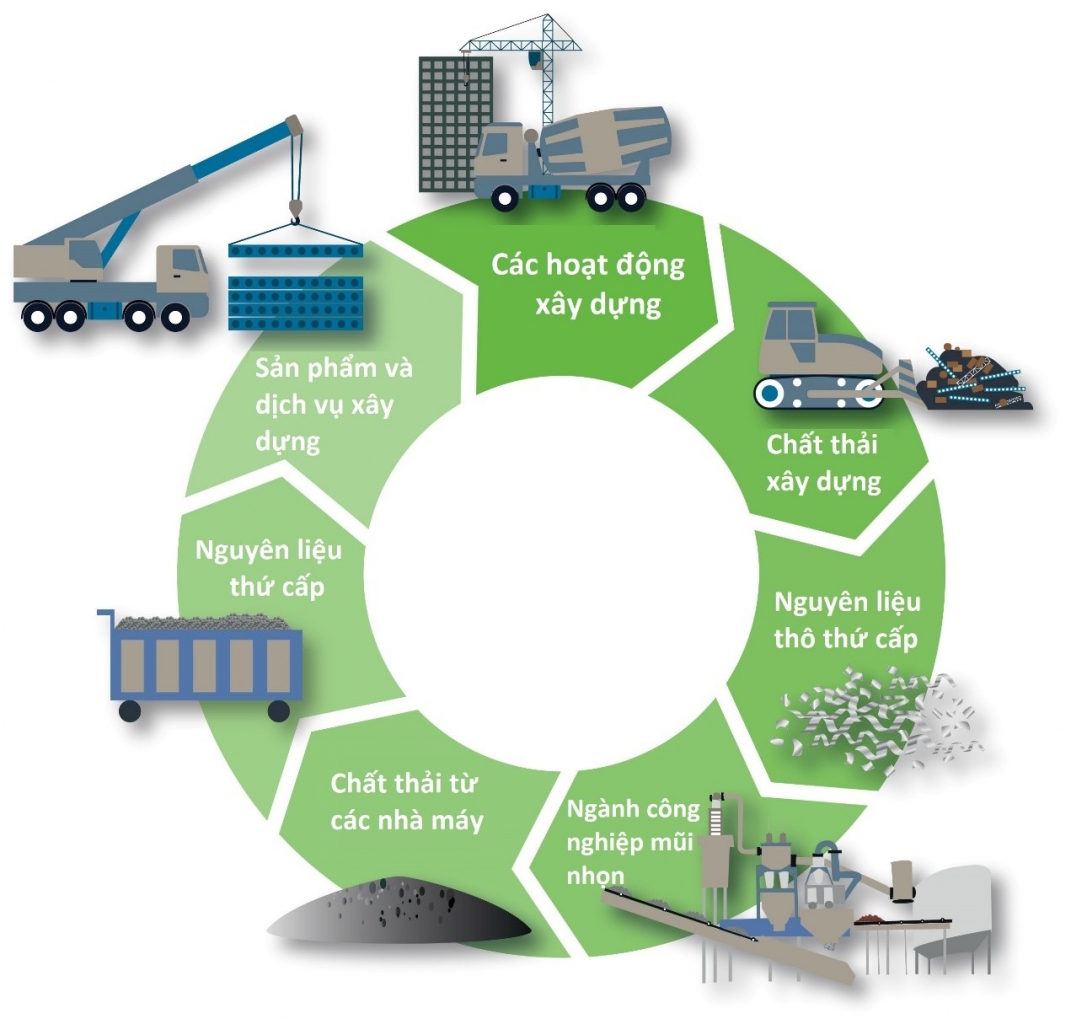
Industrial symbiosis
In nature, symbiosis is often defined as “any mutually beneficial relationship between individuals of different species”, an exchange between different actors that results in a collective benefit greater than the sum of the individual benefits. Similar approaches can also be implemented in human industrial environments. Linked to the concept of industrial ecology, industrial symbiosis is defined as an innovative form of increasing resource productivity and is one of the approaches to realizing a circular economy and achieving green growth.
According to Clause 2, Article 2 of Decree 82/2018/ND-CP regulating the management of industrial parks and economic zones, (effective July 10, 2018), Industrial symbiosis in industrial parks is a cooperative activity between enterprises in an industrial park or with enterprises in other industrial parks to optimize the use of input and output factors such as raw materials, water, energy, waste, scrap... in the production and business process. Through cooperation, enterprises form a network to exchange factors serving production, share infrastructure and services serving production, improve technological processes and enhance the efficiency of production and business activities. Therefore, industrial symbiosis contributes to saving costs and minimizing resource use by jointly maximizing the output that can be created, thereby bringing economic and environmental benefits. First of all, industrial symbiosis increases profitability and competitiveness, creating opportunities for companies today – both private and public. Secondly, it brings significant benefits to the environment by reducing the demand for materials and waste.
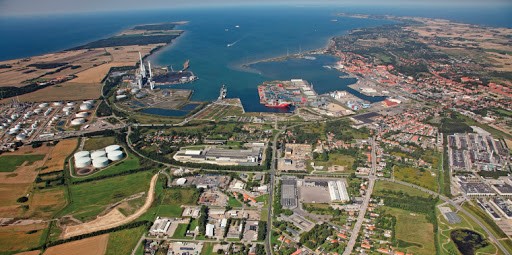
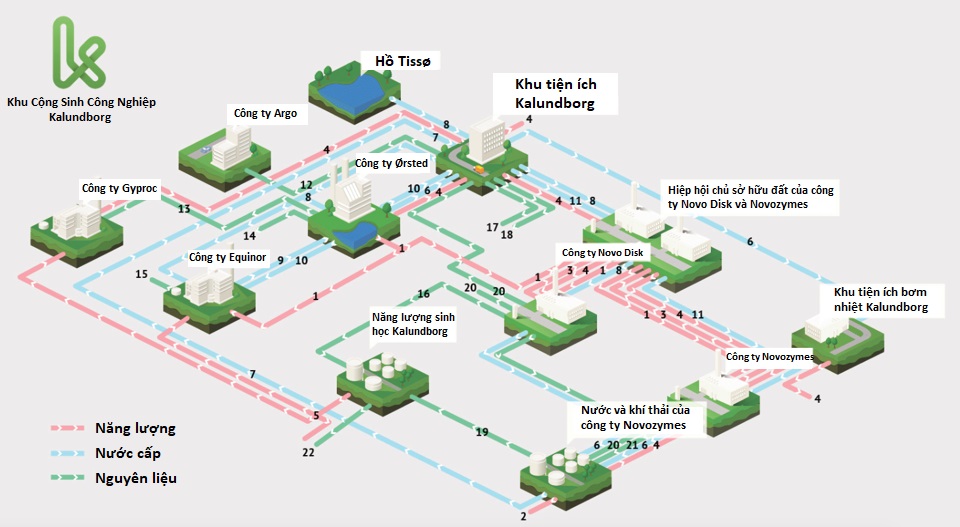
The Kalundborg Eco-Industrial Park in Denmark
The benefits of industrial symbiosis include low energy use, CO2 savings, reduced water consumption and reduced waste disposal.
Take the Kalundborg Industrial Park in Denmark, for example, which is considered the world's first industrial symbiosis model and has been operating since the 1970s. Thanks to the application of industrial symbiosis, the Kalundborg Industrial Park has reduced resource consumption and reduced waste discharge into the environment:
| Reduce resource consumption | Reduce emissions | Recycle and recover waste |
| Oil: 30,000 tons |
CO2: 130,000 tons |
Fly ash: 65,000 tons |
|
N: 1,300 tons |
SO2: 380 tons |
Sulfur: 4,500 tons |
|
Water: 1,200,000 m3 |
H2S: 2,800 tons |
Liquid biomass: 280,000 m3 |
| Phosphorus: 550 tons |
|
Solid biomass: 97,000 m3 |
| Gypsum: 100,000 tons |
|
|
Regarding the application of the eco-industrial park model in Vietnam, there are currently more than 72 enterprises participating and applying solutions for efficient use of resources and clean production (RECP), contributing to improving resource efficiency, helping to save nearly 75 billion VND annually through cutting 17.8 million kWh of electricity, 439,000 cubic meters of water and a significant amount of other resources and fuels.
Particularly at Hoa Khanh Industrial Park (Da Nang), according to preliminary assessment of the pilot results, participating companies have saved 5-10% of electricity, 3-5% of water, and reduced CO2 emissions by 510 tons/year, etc. The above results show great potential in saving resources in Vietnam's industrial parks, gradually forming ecological industrial parks.
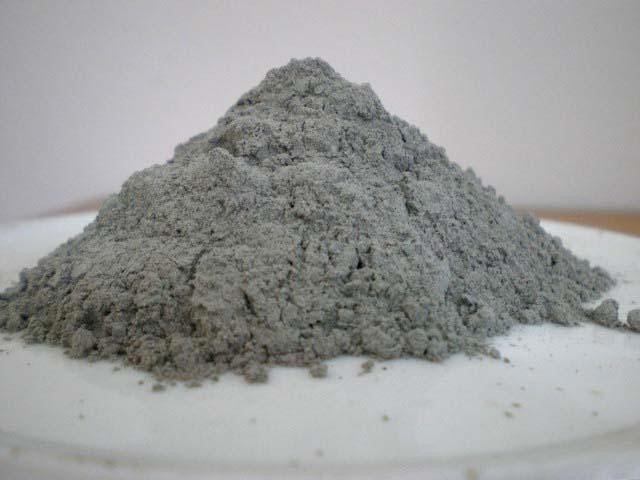
Coal ash by-products are used in industrial symbiosis activities
In particular, regarding the reuse of by-products and waste from environmental industries, industrial symbiosis activities can be applied to treat waste such as sludge and coal ash for reuse or to create new products such as fertilizers for agriculture or the production of unburnt bricks.
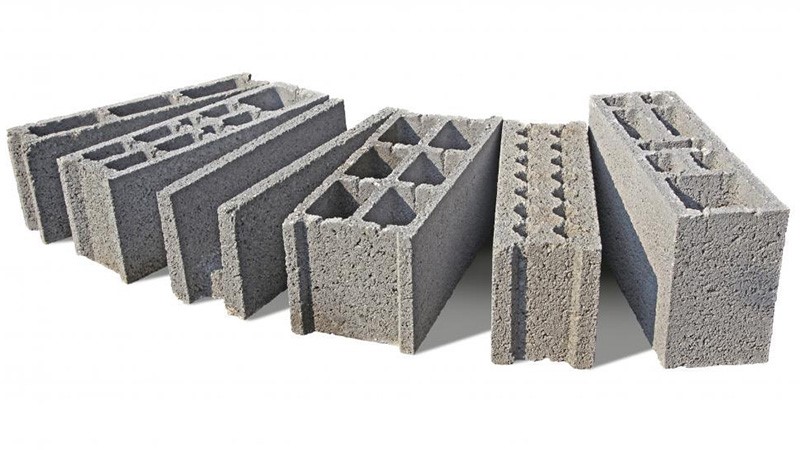
Unburnt bricks are produced from coal ash
Industrial symbiosis is built mainly on the basis of economic benefits and the interest and commitment of enterprises. Long-term economic benefits are the top priority for sustainability as well as ensuring the promotion of the emergence and innovation of enterprises.
Industrial symbiosis is one of the methods to bring the current economy closer to the Circular Economy - an activity that helps to take advantage of cheap raw materials (such as waste, garbage, etc.) to create new value instead of throwing them away or spending more on processing. Notable in the operation of the circular economy are by-products in the rice agricultural industry such as rice husks, straw, etc. as input materials for boilers burning wood pellets pressed from rice husks. Coconut fiber shells are also reused to make carpet weaving threads, etc. The price of products created from waste depends largely on the technology used for recycling that enterprises invest in implementing.
In another aspect, an eco-industrial park (EIP) is a larger form of industrial symbiosis. It includes an area with clear geographical boundaries, no residents living there and a collection of service and production enterprises forming a "community" towards the goal of environmental protection. An EIP creates a great driving force for economic development in many countries, not only increasing investment attraction but also creating jobs for many workers. In particular, it reduces costs and increases production efficiency from the process of saving, recycling, and reusing resources - materials and energy thanks to the application of industrial symbiosis.
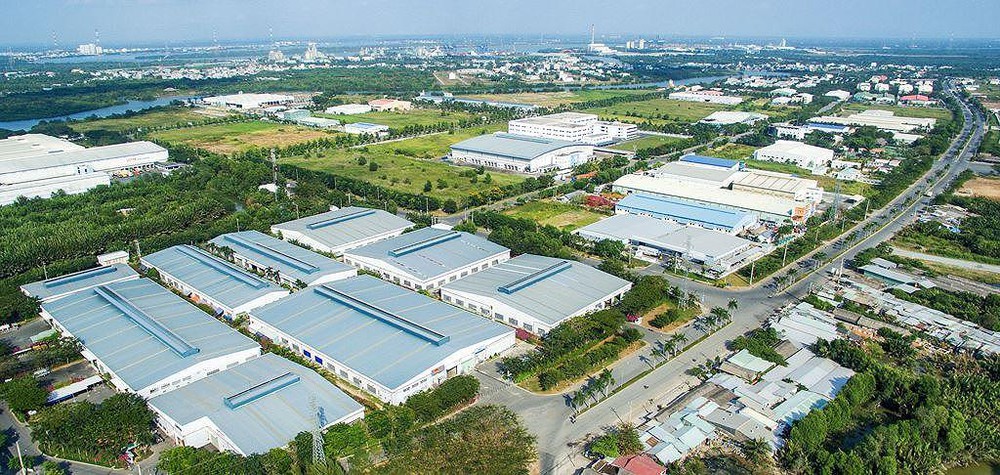
Eco-industrial parks are a solution for ‘green’ growth in Vietnam (Photo: VOV)
Eco-industrial parks are increasingly being focused on development, creating a premise and solid foundation for the development of green industrial parks. Currently, the Ministry of Planning and Investment has continued to coordinate with UNIDO and the Swiss State Secretariat for Economic Affairs (SECO) to launch the Project “Implementing Eco-industrial Parks in Vietnam following the approach from the Global Eco-Industrial Park Program”, which promises to bring a bright future for eco-industrial parks in Vietnam.
The development of the industrial symbiosis model as well as the expansion of eco-industrial parks will be a promising step forward for environmental industries in particular and the Vietnamese economy in general. This will bring great benefits to economic growth while reducing negative impacts on the environment and human health, contributing to the implementation of the green growth strategy and sustainable development of an environmentally friendly economy in Vietnam in the future.
Nanoen
NANO ENVIRONMENT TECHNOLOGY - CONSTRUCTION LIMITED LIABILITY COMPANY
Address: 661E/29, Vo Van Kiet Street, Binh Yen A Quarter, Long Hoa Ward, Binh Thuy District, Can Tho City
Hotline: 0941.777.519 - 0907.803.678 - 0901.229.798
Email: nanoentech@gmail.com
Facebook: www.facebook.com/nanoentech