


The environment has become one of the issues that attracts the attention of the whole society. Because pollution affects the living environment and human health. The wastewater treatment system (WTP) is a wastewater treatment tool that meets the discharge standards according to current laws, ensuring the legality of businesses when discharging waste, contributing to environmental protection.
However, the cost of WTP is always one of the problems that need to be solved by businesses and manufacturing enterprises. The question for this issue is how to save WTP costs but still bring optimal efficiency? This cost actually depends on many factors such as: type of wastewater, factory scale, applied treatment method, etc.
In addition to the above factors, to save costs, we need to understand the chemical properties of the chemicals used, the necessary conditions for creating and occurring reactions, and the pollutants in wastewater to ensure that the treatment process is highly effective, does not create highly toxic by-products, and most of all, saves costs during the implementation process.
First, one of the indispensable methods to save and use the appropriate amount of chemicals is to perform the Jartest experiment. The Jartest experiment is an important test in wastewater treatment, aiming to find the optimal parameters in the chemical treatment process, reduce pollutants and increase treatment efficiency. When conducting the experiment, users can compare, select chemicals, optimal chemical dosage, optimal stirring speed, determine the necessary parameters for the treatment process, making the wastewater treatment stages of the factory easier and more effective. From there, choose the appropriate type of chemicals and accompanying equipment for the physical and chemical treatment process of the treatment system.
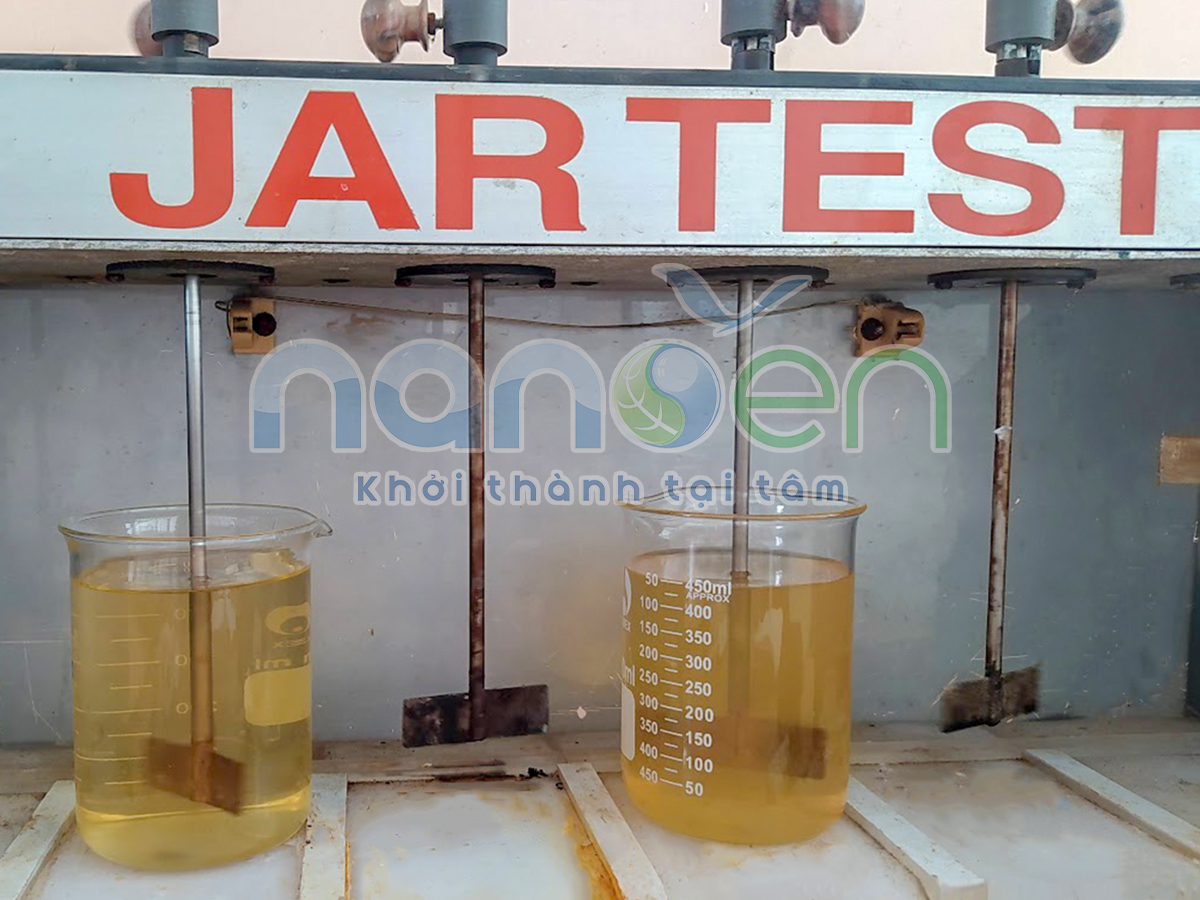
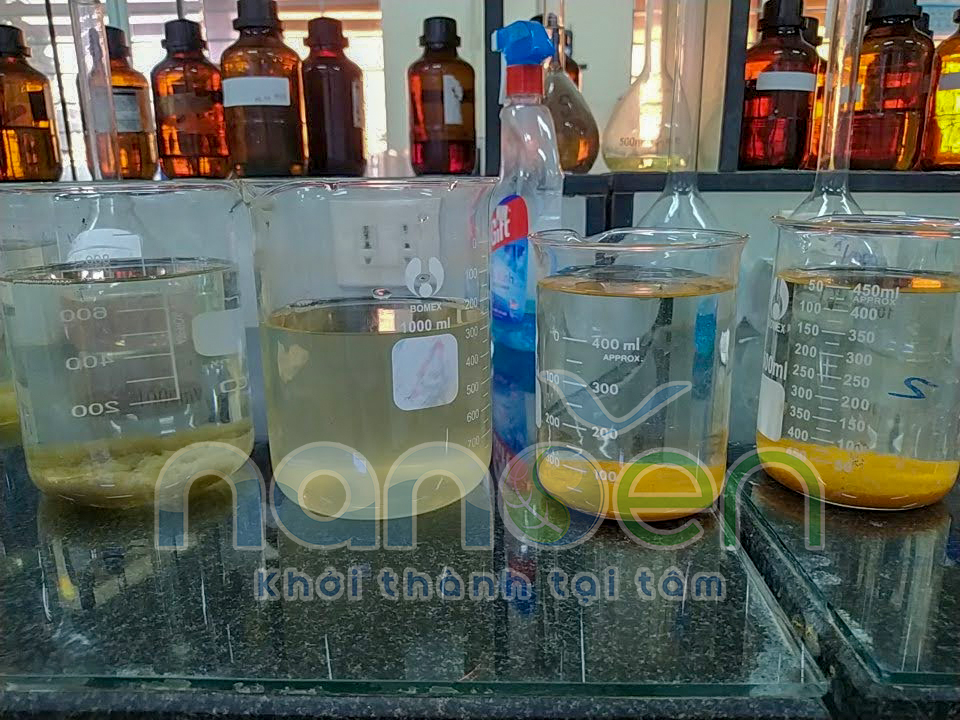
Jartest experiment (Source: Nano Environment Company; photo taken from the actual experiment)
The main factors for a highly effective chemical treatment process include:
-
Dosage of chemicals used:
Too low a dose is not enough for the reaction to occur, not removing pollutants to the expected level. Using too high a dose leads to the opposite reaction: cloudy water, stable colloidal particles, and additional chemical costs.
During the coagulation process, sometimes it is necessary to use supporting measures for better coagulation and flocculation. Below are 4 main groups of measures:
+ Add polymer to wastewater;
+ Add alkalinity to wastewater;
+ Adjust the pH of wastewater;
+ Increase the density of particles in wastewater.
-
For chemicals to have good contact with pollutants and react, stirring conditions are very important
+ Stage 1: Stir quickly in a short time with the purpose of quickly diffusing chemicals, breaking the stable state of the colloidal system in water.
+ Stage 2: Stir slowly with the purpose of making flocculating elements, turbidity-causing elements, and water-coloring elements have better conditions to contact each other. To avoid large flocs from forming without being broken, the stirring intensity must be gradually reduced.
-
Reaction time of chemical treatment tank
Is the water retention time of the reaction tank: If the reaction time is too fast, the reaction between chemicals and pollutants does not occur in time, leading to poor output water quality.
-
Reaction condition
Depending on each reaction such as pH, temperature, ..., different reaction conditions will be required.
- pH: depending on the pH threshold of the wastewater to choose the appropriate coagulant chemical. To know the appropriate pH for the operation of the coagulant, please refer to the table below with Nanoen.
Table: Suitable pH for the operation of the coagulant
| Suitable | pH chemicals |
|
Al 2(SO 4) 3 |
4,0 – 7,0 |
|
FeSO 4 |
>8,5 |
|
FeCl 3 |
4,0 – 6,5 và >8,5 |
|
Fe 2(SO 4) 3 |
3,5 – 7,0 và >9,0 |
(Aboulhassan et al. 2006)
In addition, in another study, the coagulation process using FeCl3 will be effective at pH from 7 ÷ 9
- Temperature:
+ Low temperature will reduce the efficiency of the coagulation process, especially when using alum, so iron alum should be used instead of alum.
+ High temperature can increase the coagulation process due to the following mechanisms: increasing the reaction rate, reducing the time required to form flocs, reducing the viscosity of water, changing the structure of large flocs.
Through the above article, Nanoen hopes that customers will better understand the optimal use of chemicals in the operation of the wastewater treatment system. In the coming time, to continue the success of the previous course (Training Course on Operation of Wastewater Treatment Systems organized by Nanoen in collaboration with the Faculty of Environment and Natural Resources - Can Tho University), Nanoen plans to organize a Training Course on Operation on the topic "Chemical treatment methods in the operation of wastewater treatment systems". We hope that Nanoen will receive the attention and participation of our customers.
A reputable unit providing environmental records and construction, operation, maintenance - maintenance of wastewater treatment systems
Nanoen is a unit operating in the environmental field, during its operation, Nanoen has received the trust of customers for its honesty, dedication and responsibility towards customers and the company's products.
With a team of experienced staff, we have a full range of services from environmental profile consulting to construction design, environmental treatment system operation, microbiological supply, sludge pressing for hire...
Nanoen is always ready to bring the best service experience, suitable for the needs of our customers.
Nanoen
NANO ENVIRONMENT TECHNOLOGY - CONSTRUCTION LIMITED LIABILITY COMPANY
Address: 661E/29, Vo Van Kiet Street, Binh Yen A Quarter, Long Hoa Ward, Binh Thuy District, Can Tho City
Hotline: 0941.777.519 - 0907.803.678 - 0901.229.798
Email: nanoentech@gmail.com
Facebook: www.facebook.com/nanoentech