

QCVN 14:2025/BTNMT — the National Technical Regulation on Domestic and Municipal Wastewater — was issued together with Circular No. 05/2025/TT-BTNMT and took effect on September 1, 2025.
Entities covered by the transitional provisions may continue applying the previous regulations through December 31, 2031; from January 1, 2032, they must comply with QCVN 14:2025/BTNMT. Meanwhile, new investment projects, projects involving scale expansion, and projects involving capacity increases that submit environmental dossiers after September 1, 2025 must apply the new regulation as prescribed.
One notable change under QCVN 14:2025/BTNMT is that effluent limits are specified directly in Columns A, B, and C, based on discharge zoning and the designated function of the receiving water body. In addition to BOD, COD, and TSS, parameters such as ammonium, Total Nitrogen, and Total Phosphorus should also be considered when assessing whether an existing domestic wastewater treatment system can comply.
See also: Changes to Vietnam’s 2025 Wastewater Technical Regulations: What Should Businesses Prepare For?
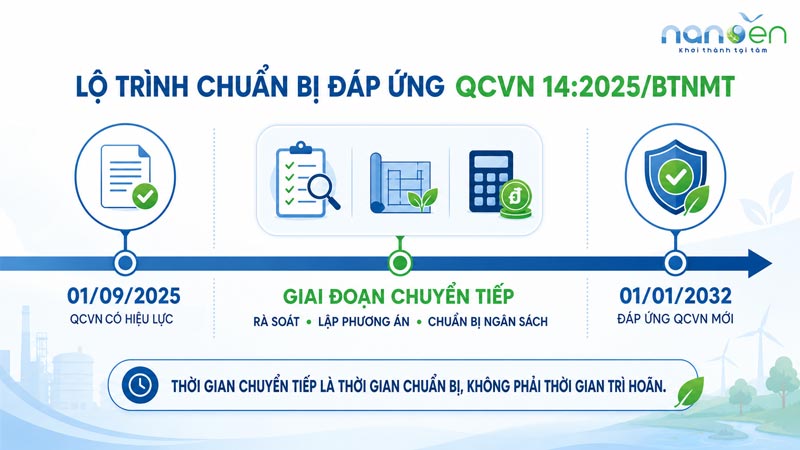
Roadmap for Preparing to Comply with QCVN 14:2025/BTNMT by 2032
In this article, Nanoen’s focus is no longer limited to the question, “When must QCVN 14:2025/BTNMT be applied?” The more important questions are what limitations exist in the current domestic wastewater treatment system and whether a retrofit plan should be prepared before the new regulation becomes mandatory.
Being allowed to continue applying the previous standard does not mean a business should wait until 2032 is approaching before assessing its system. Site surveys, sampling, option selection, budgeting, and construction planning all take time. An early review helps the business prepare proactively and avoids rushed retrofits or technology choices made before the actual cause has been identified.
The following sections therefore focus on the key items to review in an existing domestic wastewater treatment system and the potential application of MBBR, MBR, AAO, and SBR when a retrofit or upgrade is required.
What Should Be Reviewed in an Existing Wastewater Treatment System?
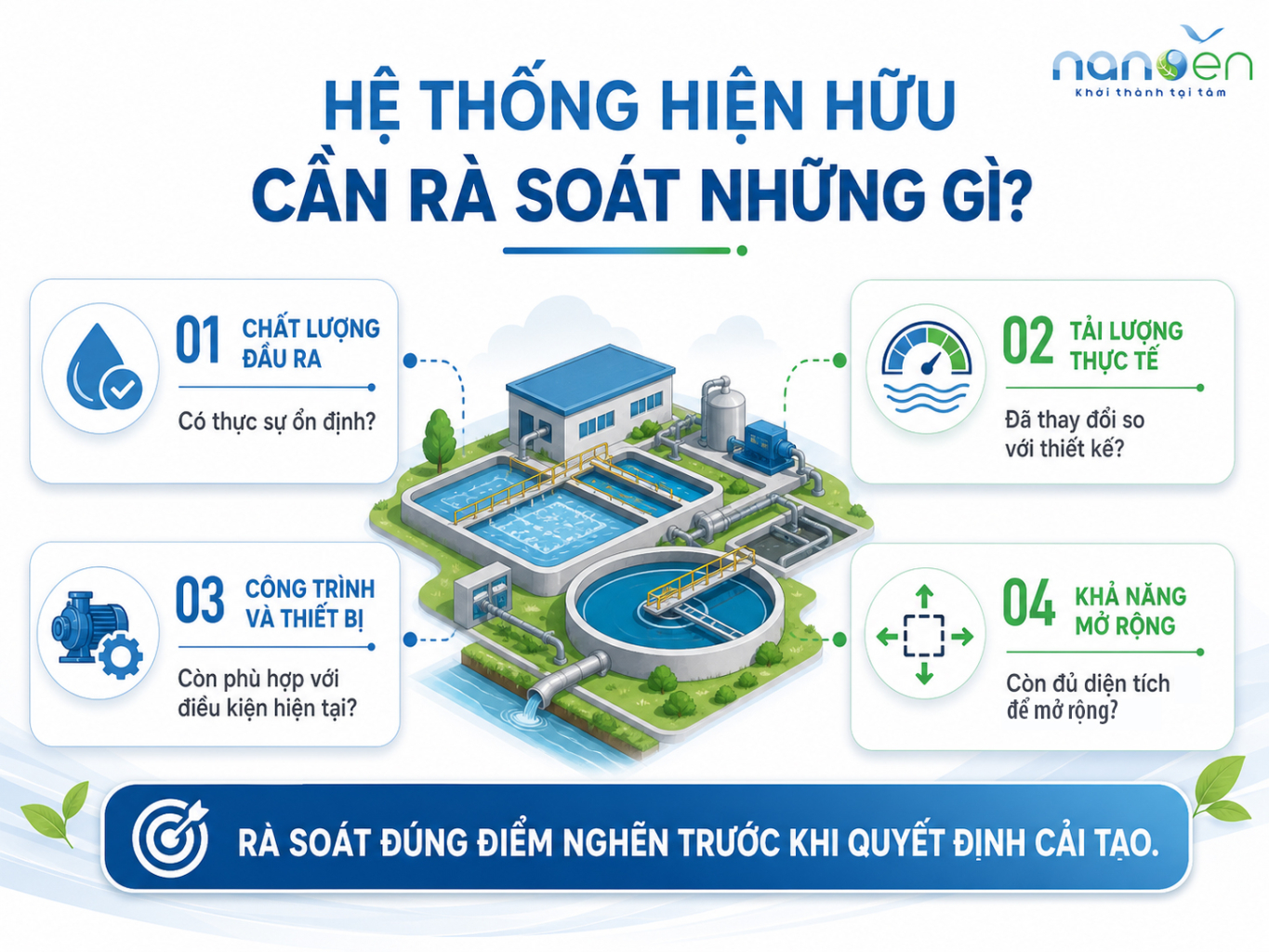
Key Areas to Review in an Existing Wastewater Treatment System
1. Is the Effluent Quality Genuinely Stable?
A few compliant test results are not enough to conclude that the system is operating well.
The business should review data over a sufficiently long period to identify parameters that frequently fluctuate or approach their applicable limits.
In addition to BOD, COD, and TSS, particular attention should be paid to the control of ammonium, Total Nitrogen, and Total Phosphorus. If BOD and COD remain relatively stable while nitrogen or phosphorus frequently fluctuates, the bottleneck may lie not in the system’s overall capacity but in its biological process configuration.
From the project owner’s perspective, the key concern is not merely whether a result is “compliant” or “non-compliant” at one point in time, but how stable the system is and how much compliance margin it retains as the load changes.
2. How Much Has the Actual Load Changed from the Design Basis?
The rated capacity stated in the project documents does not fully reflect the system’s actual treatment capability.
Even if wastewater flow has not increased significantly, a change in influent pollutant concentration can still increase the load on the treatment units. The system may then experience oxygen limitation, unstable sludge, or fluctuating effluent quality.
The business should therefore assess flow, wastewater characteristics, and actual operating conditions together. The objective is to determine whether the system still has reserve treatment capacity or has reached a limit that requires retrofitting.
3. Are the Civil Structures and Equipment Still Suited to Current Conditions?
After a period of operation, pumps, blowers, mixers, air distribution systems, and other equipment may no longer perform as efficiently as they did initially.
In addition to equipment condition, the business should consider whether existing tanks can be reused, the condition of the civil structures, and how practical it would be to carry out repairs or retrofits.
A system that does not meet requirements does not necessarily need a complete process replacement. In some cases, the cause may be the equipment, the operating regime, or a specific treatment stage that is limiting overall performance.
4. Is There Still Space for Physical Expansion?
This is a common challenge at apartment buildings, hotels, hospitals, shopping malls, and fully developed residential areas.
When the load increases but there is no space for additional tanks, the retrofit must focus on increasing treatment capacity within the existing tank volume or using a process with a higher treatment intensity.
This constraint is one reason why MBBR, MBR, AAO, and SBR are commonly considered during option assessment.
Comparison and Application of MBBR, MBR, AAO, and SBR in Domestic Wastewater Treatment
No single technology is best for every system. The appropriate choice depends on the specific problem the business needs to solve.
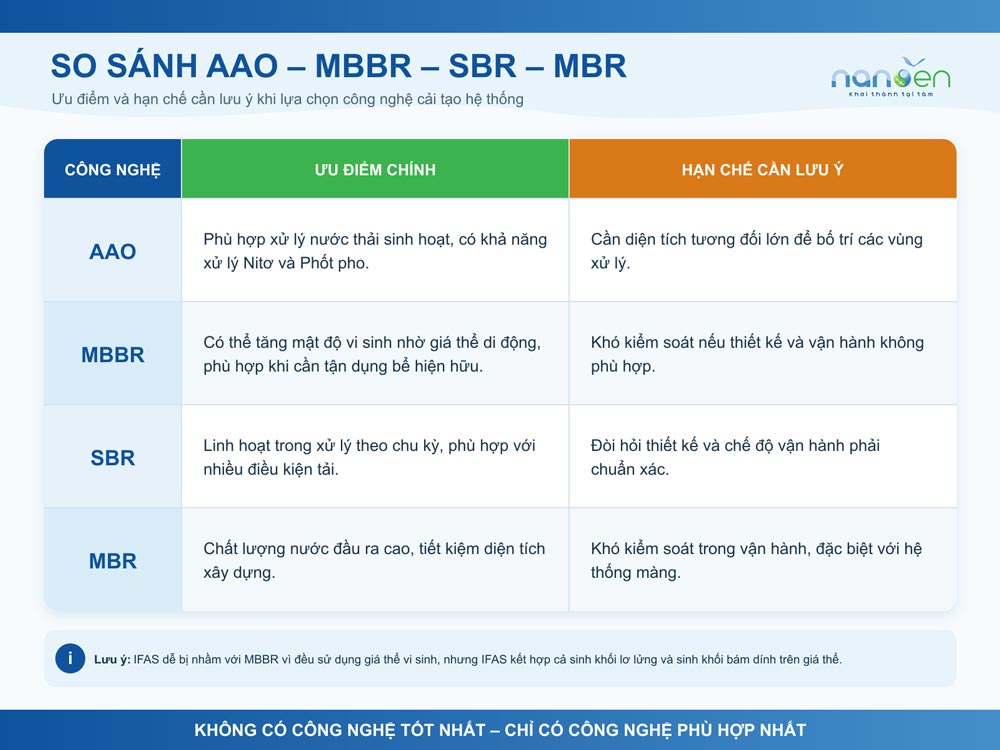
Comparison of the Advantages and Limitations of AAO, MBBR, SBR, and MBR
MBBR — Increasing Biomass Density in Existing Tanks
MBBR uses moving carriers as attachment surfaces for biofilm growth, supporting the removal of organic carbon and nitrogen while providing an effective option for retrofitting existing treatment units and increasing their capacity.
However, an upgrade is not as simple as adding more carriers to a tank. To achieve the required performance, the load, media fill fraction, aeration system, hydraulic regime, and media retention screens must be recalculated as an integrated system.
MBR — Prioritizing Footprint and Effluent Quality
MBR combines biological treatment with membrane separation to separate treated water from biomass. This allows the process to maintain a high mixed-liquor concentration and reduce its dependence on secondary clarification.
MBR’s strengths are its compact footprint and high effluent quality. However, energy consumption, membrane cleaning, fouling control, and membrane replacement must be considered when evaluating the long-term solution.
When comparing MBBR and MBR, a business should therefore look beyond treatment efficiency alone. If the primary objective is to reuse existing tanks and increase biomass, MBBR may be worth considering. If the main constraint is space and the required effluent quality is high, MBR may be more suitable.
AAO — When Nitrogen and Phosphorus Are the Bottlenecks
AAO treatment for domestic wastewater creates three zones — anaerobic, anoxic, and aerobic — to provide different biological conditions for organic matter removal and nutrient removal.
Biological nitrogen and phosphorus removal depends on wastewater characteristics, the available carbon source, nutrient ratios, and operating conditions. AAO performance should therefore be evaluated using actual data rather than the process flow diagram alone.
AAO is particularly relevant when the existing system performs relatively well for BOD and COD but struggles to control Total Nitrogen or Total Phosphorus.
SBR — Flexibility through Controlled Operating Cycles
SBR is a batch-operated activated sludge process in which filling, reaction, settling, and decanting occur sequentially in the same tank. SBR can be applied to municipal and industrial wastewater, and its operating phases can be adjusted to support nitrification and nutrient removal.
SBR can combine several treatment stages in the same tank and adapt flexibly to load variations. In return, the operating cycle, equipment, and operating regime must be well controlled.
Do Not Start a Retrofit by Choosing the Technology
MBBR, MBR, AAO, and SBR are tools for solving specific problems.
Before selecting a technology, the current system’s limiting factor should be identified. Possible causes include:
-
The organic load exceeds the design capacity;
-
Nitrogen and phosphorus removal is not stable;
-
There is insufficient space to expand the treatment works; or
-
Existing tanks cannot be readily reused, or the equipment and operating regime are unsuitable.
Correctly identifying the cause provides the basis for selecting an appropriate retrofit approach and treatment technology.
A system that does not meet the required performance does not necessarily need to be rebuilt in full. The solution may involve adjusting the operating regime, repairing or replacing equipment, modifying selected tanks, or adding a process to the existing works.
For the project owner, an appropriate solution must not only meet the effluent requirements but also balance the reuse of existing structures, capital cost, operating requirements, and disruption to ongoing activities.
Nanoen Supports Condition Assessments and Retrofits for Existing Wastewater Treatment Systems
No single technology is optimal for every wastewater treatment system. The appropriate solution must be based on wastewater characteristics, actual loading, effluent requirements, site constraints, and the operating capability of each business.
A system retrofit should therefore begin with a site survey and condition assessment, rather than with the selection of a currently popular technology.
Nanoen focuses on reviewing the factors that directly affect the project owner’s decision, including:
-
Applicable legal requirements and effluent quality;
-
System stability;
-
Actual reserve treatment capacity;
-
Condition of the civil structures and equipment;
-
Potential to reuse the existing system; and
-
Site constraints and construction planning.
Based on the assessment results, Nanoen identifies the factors limiting treatment performance and recommends an appropriate course of action: operating adjustments, targeted retrofits, equipment replacement, or the addition of treatment technology where genuinely necessary.
During the preparation period for QCVN 14:2025/BTNMT in particular, an early assessment gives the business more time to develop a budget, select an appropriate solution, and schedule implementation.
The transition period is not a reason to delay; it is the time available for businesses to prepare proactively for the requirements that will apply in the next stage.
Contact Nanoen via hotline 0941 777 519 - 0907 803 678 - 0901 229 798 to discuss an assessment or retrofit of your existing wastewater treatment system.
Nanoen
NANO ENVIRONMENT TECHNOLOGY - CONSTRUCTION LIMITED LIABILITY COMPANY
Address: 661E/29 Vo Van Kiet, Long Tuyen Ward, Can Tho City
Hotline: 0941 777 519 - 0907 803 678 - 0901 229 798
Email: nanoentech@gmail.com
Facebook: www.facebook.com/nanoentech