


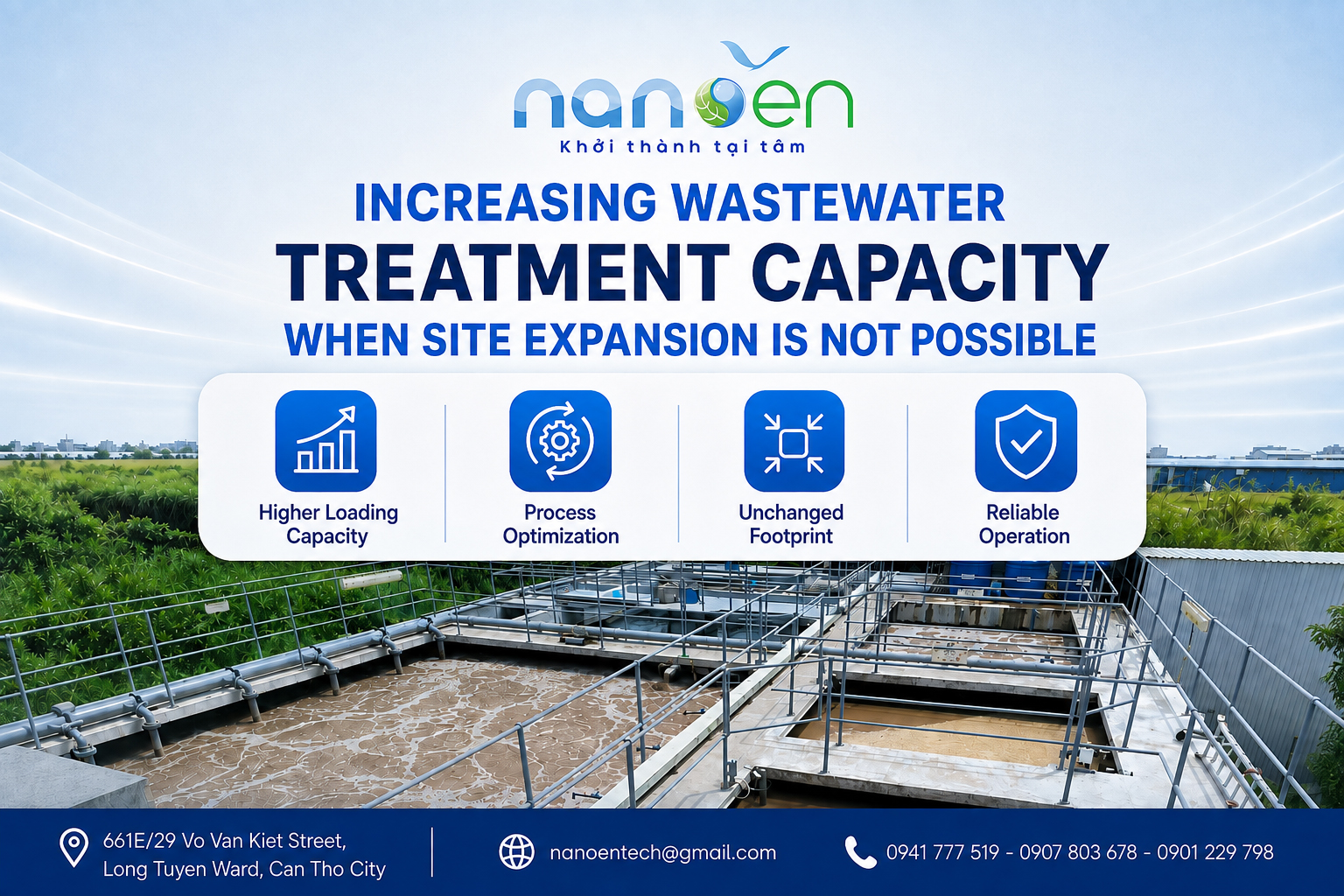
When production increases, both wastewater flow and pollutant loads entering the wastewater treatment system may also change. However, not every industrial facility has sufficient space to construct additional tanks or expand the entire treatment system.
In this situation, the key question is not simply “Which technology should be added?” Instead, businesses need to determine where the existing system is currently constrained, which components can still be utilized, and which retrofit option can increase treatment capacity while minimizing disruption to production.
How Does Nanoen Approach Wastewater Treatment Capacity Upgrades?
Nanoen supports project owners in identifying the underlying causes of treatment limitations before selecting a technology.
The assessment process focuses on:
-
effluent quality requirements;
-
actual wastewater flow and pollutant loads;
-
condition of existing structures and equipment;
-
system bottlenecks;
-
potential for reusing existing treatment units; and
-
site and construction conditions.
Based on the assessment results, the project owner can determine:
-
the actual factors limiting treatment capacity;
-
which structures and equipment can still be utilized;
-
suitable retrofit options based on budget and operating conditions; and
-
an implementation roadmap that minimizes disruption to production.
Depending on the actual condition of the system, the solution may involve optimizing operation, replacing equipment, retrofitting selected treatment units, or adding treatment technology only where necessary.
Related service: Wastewater Treatment System Retrofit
Before selecting a retrofit option, businesses should first review changes in production activities and operating conditions of the existing wastewater treatment system.
This helps determine whether additional treatment capacity is actually required or whether the problem is primarily caused by specific operational limitations. MK_27.08.2026_Nâng công suất HTXLNT khi không có mặt bằng.docxDOCX
When Should a Business Consider Increasing Wastewater Treatment Capacity?
The need for a capacity upgrade commonly arises when a business expands production, installs additional production lines, or changes its product portfolio.
Businesses should consider reviewing their wastewater treatment system when one or more of the following conditions occur:
-
Wastewater flow exceeds the design capacity.
-
Wastewater characteristics change after new raw materials, products, or production lines are introduced.
-
Treated effluent fails to meet the applicable discharge standards, particularly during peak production periods.
-
Poor sludge settling or frequent sludge carryover occurs in the clarifier.
-
The business plans to increase its production scale or production capacity.
Treatment capacity does not depend solely on total wastewater volume.
Even at the same flow rate, wastewater containing higher concentrations of oil and grease, organic matter, or suspended solids may impose a greater treatment load on the system.
Changes in raw materials, products, or cleaning processes may alter both the composition and concentration of pollutants. As a result, physicochemical treatment, biological treatment, or solids separation units may become overloaded even when the total wastewater flow remains unchanged.
Therefore, before investing in additional treatment capacity, businesses should first determine whether the system is:
-
hydraulically overloaded;
-
overloaded by pollutant load; or
-
operating below its actual potential due to inappropriate operating conditions.
6 Factors to Review Before Investing in a Wastewater Treatment System Upgrade
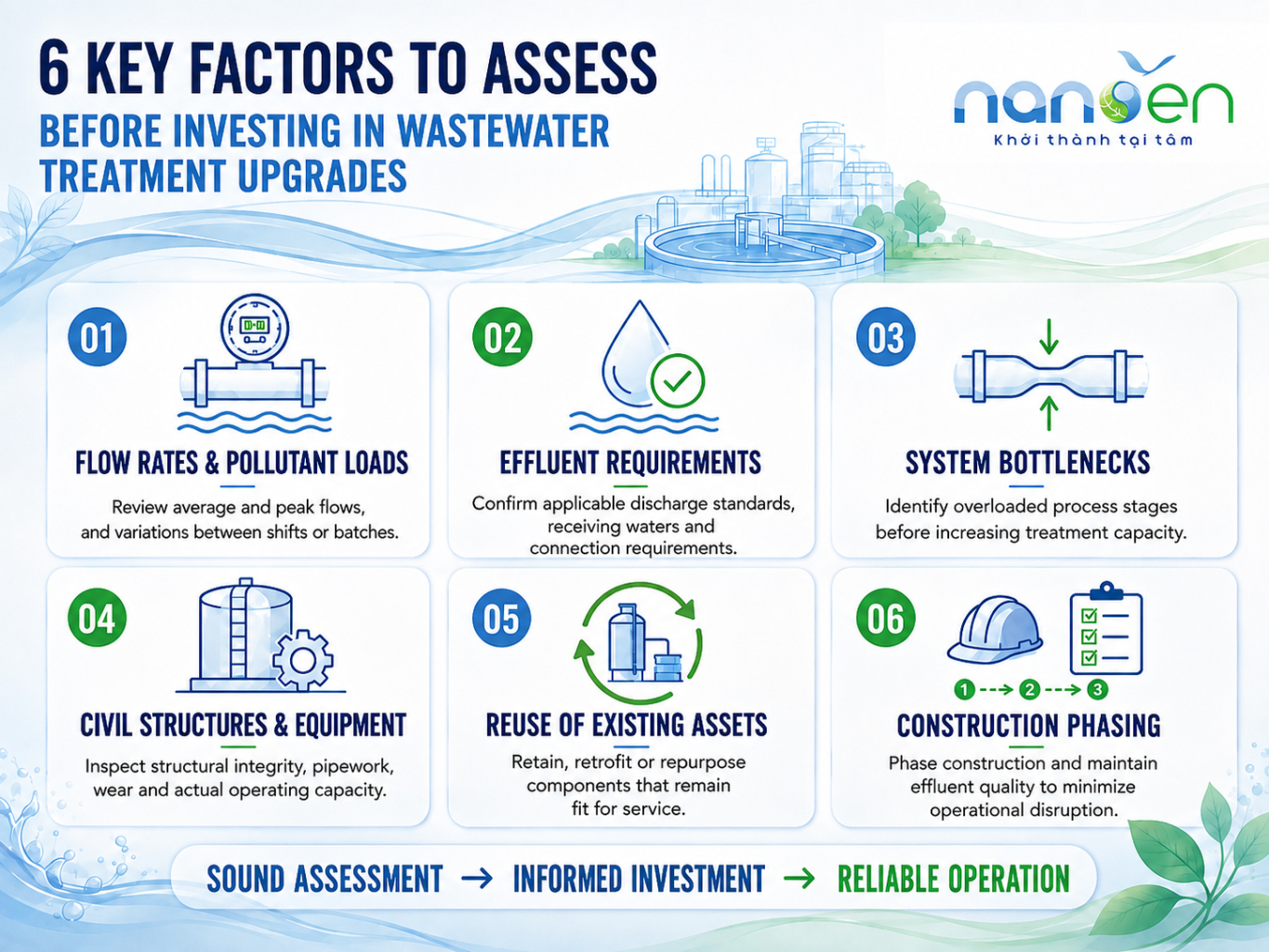
1. Instantaneous Flow and Actual Pollutant Load
Businesses should not assess system capacity based solely on total daily wastewater volume.
High flow rates during certain periods may overload the equalization tank or downstream treatment units.
The design capacity should therefore be compared with:
-
average wastewater flow;
-
peak flow;
-
variations between production shifts; and
-
batch-related wastewater fluctuations.
A wastewater treatment system may become overloaded during certain periods even when the total daily wastewater volume remains below its design capacity.
2. Effluent Quality Requirements
Effluent requirements may change depending on:
-
the applicable environmental regulation;
-
the receiving water body; or
-
wastewater discharge or sewer connection requirements.
When more stringent effluent limits apply, the existing system may need to control additional parameters or incorporate additional treatment stages.
Therefore, the retrofit objective should always be based on the current discharge or connection requirements.
If the required effluent quality changes, the treatment system may also need to be modified accordingly.
3. System Bottlenecks
The actual bottleneck should be identified before concluding that the entire wastewater treatment system lacks capacity.
The limitation may be located in:
-
pretreatment;
-
the equalization tank;
-
biological treatment;
-
clarification;
-
sludge treatment; or
-
mechanical equipment.
For example, if the biological treatment stage still has sufficient capacity but the clarifier frequently experiences sludge carryover, enlarging the biological tank may not solve the actual problem.
In this case, the bottleneck lies in solids separation rather than biological treatment capacity.
4. Condition of Existing Structures and Equipment
The condition of structures and equipment depends on each facility's operating conditions, maintenance practices and operating history.
Existing tanks should be inspected for:
-
structural condition;
-
waterproofing;
-
piping configuration; and
-
potential for modification or reuse.
Equipment should also be evaluated based on:
-
actual operating capacity;
-
deterioration and wear; and
-
available standby capacity.
Reduced equipment performance can sometimes lead businesses to mistakenly conclude that the entire wastewater treatment system has insufficient capacity.
5. Potential to Reuse the Existing Treatment System
Existing tanks, pipelines and equipment that remain suitable may be retained, modified or assigned new functions.
Correctly identifying reusable assets can help reduce:
-
new construction requirements;
-
investment costs; and
-
construction time.
This is particularly important for industrial facilities where physical expansion is limited.
6. Construction Planning
Retrofit work should be implemented in stages to minimize disruption to production.
To maintain stable operation of the wastewater treatment system during the retrofit process, businesses need a clear plan for:
-
construction phasing;
-
temporary operation arrangements; and
-
effluent quality control.
For facilities that must continue production during construction, implementation planning is therefore a critical part of the capacity upgrade strategy. MK_27.08.2026_Nâng công suất HTXLNT khi không có mặt bằng.docxDOCX
Options for Increasing Wastewater Treatment Capacity When Space Is Limited
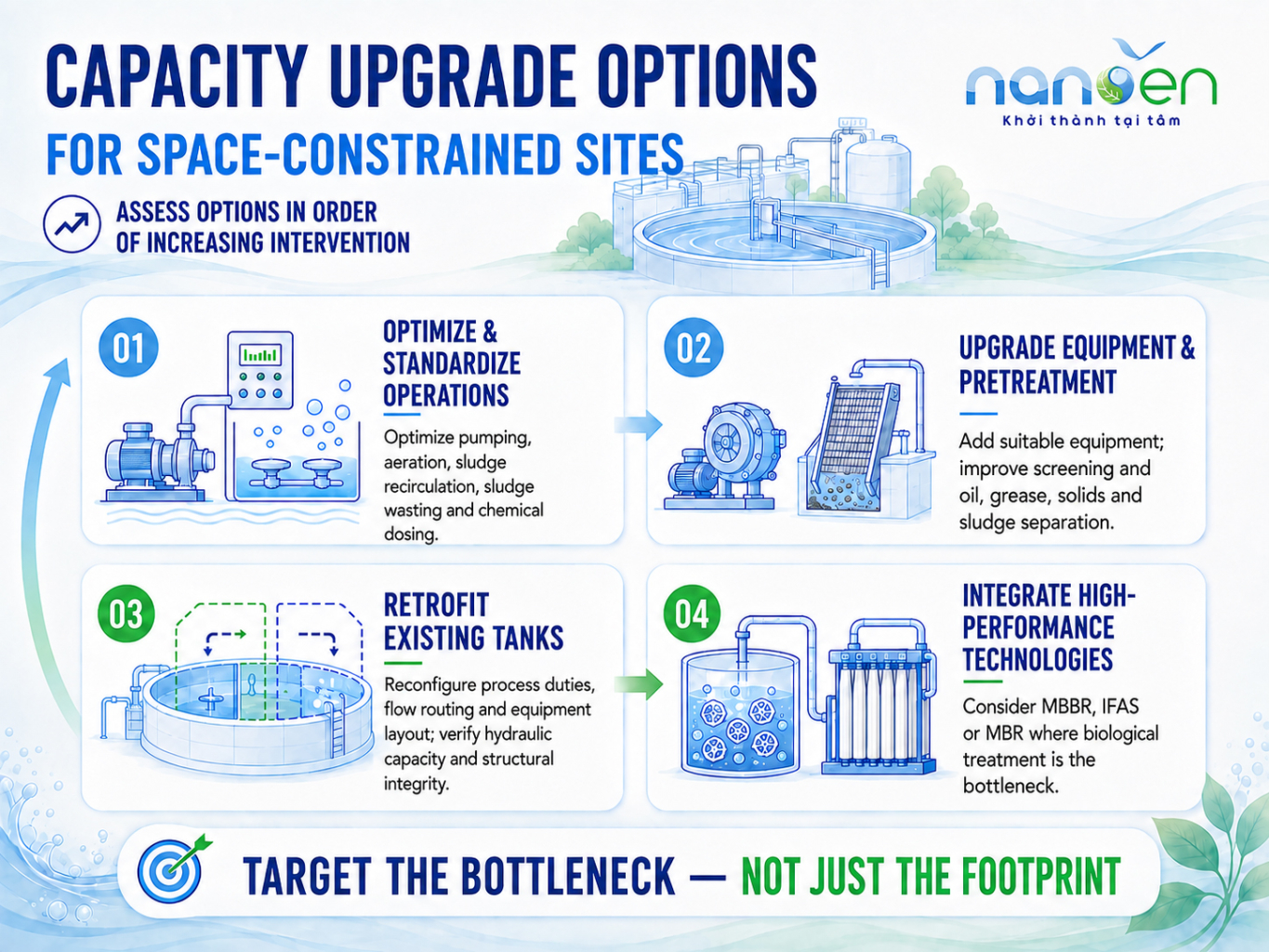
There is no single solution that is suitable for every wastewater treatment system.
Businesses should evaluate available options according to an increasing level of intervention.
Level 1: Optimize and Standardize Operation
Operational adjustments may include:
-
pump operation;
-
aeration;
-
sludge recirculation;
-
sludge wasting; and
-
chemical dosing.
Proper optimization may help stabilize the treatment system and improve utilization of its existing capacity.
However, if the influent load has already exceeded the system's actual treatment capacity, simply increasing chemical consumption or extending equipment operating time will increase operating costs without necessarily providing a sustainable solution.
Level 2: Upgrade Equipment and Pretreatment
In some cases, increasing capacity may only require upgrading or adding equipment such as:
-
pumps;
-
blowers;
-
mixers;
-
aeration systems;
-
screening equipment; or
-
sludge separation equipment.
For wastewater containing high concentrations of oil, grease or suspended solids, improving equalization, coagulation–flocculation, dissolved air flotation or sedimentation may reduce the pollutant load entering the biological treatment stage.
Equipment should therefore be selected according to the actual treatment requirement rather than simply replacing existing units with larger equipment.
Level 3: Reconfigure Existing Treatment Tanks
Existing tanks may be:
-
subdivided;
-
assigned new functions;
-
connected through modified hydraulic pathways; or
-
equipped with a new internal equipment arrangement.
This approach can help businesses maximize the use of existing assets without requiring additional land.
However, the retrofit design must consider:
-
hydraulic conditions;
-
structural integrity; and
-
site construction constraints.
Level 4: Add Higher-Efficiency Treatment Technology
When biological treatment capacity is identified as the main bottleneck, technologies such as MBBR or IFAS may be considered to increase the amount of active biomass retained within an existing biological reactor.
MBR technology uses membrane separation to retain biological sludge within the treatment system, which can improve effluent quality while reducing dependence on conventional secondary clarification.
However, each technology has different requirements regarding:
-
pretreatment;
-
energy consumption;
-
maintenance; and
-
operation.
Therefore, a technology should not be selected simply because it is advertised as “space-saving.”
The more important question is whether the technology actually addresses the identified bottleneck in the existing wastewater treatment system. MK_27.08.2026_Nâng công suất HTXLNT khi không có mặt bằng.docxDOCX
What Should Project Owners Consider Beyond Initial Construction Cost?
A wastewater treatment capacity upgrade should not be evaluated solely on initial investment cost.
Businesses should also consider:
-
the ability to handle actual wastewater loads and future production plans;
-
the duration of system shutdown or restricted operation during construction;
-
electricity, chemicals, labor and maintenance costs;
-
sludge generation and sludge treatment costs;
-
operational complexity for the existing operating team; and
-
the ability to implement the project in phases and maintain sufficient standby capacity.
A solution with a lower initial investment may not necessarily be the most economical option over the entire lifecycle of the wastewater treatment system if it significantly increases operating expenses.
Similarly, increasing sludge disposal costs do not necessarily mean that the treatment system is overloaded.
Businesses should compare sludge generation with:
-
treated wastewater volume;
-
chemical consumption;
-
sludge moisture content; and
-
sludge collection and disposal costs
before determining the actual cause.
Related article: What Do Increasing Sludge Disposal Costs Reveal About a Wastewater Treatment System?
Frequently Asked Questions About Wastewater Treatment Capacity Upgrades
Does Increasing Treatment Capacity Always Require Building Additional Tanks?
No.
Some wastewater treatment systems can increase effective treatment capacity by:
-
optimizing operation;
-
upgrading equipment; or
-
reconfiguring existing tanks.
Whether additional tanks are required depends on the actual bottleneck and treatment load of the system.
Which Technology Is Best When There Is No Additional Space?
There is no single technology that is suitable for every wastewater treatment system.
The appropriate technology should be selected based on:
-
wastewater characteristics;
-
system bottlenecks;
-
effluent quality requirements;
-
available space;
-
investment budget; and
-
the operating capability of the facility.
Technologies such as MBBR, IFAS or MBR may provide advantages in certain applications, but they should only be considered after the actual limitation of the existing system has been identified.
Conduct a Site Assessment Before Making an Investment Decision
Increasing wastewater treatment capacity within an existing footprint requires businesses to balance technical performance, investment cost, implementation schedule and continuity of production.
A proper site assessment helps businesses avoid investing in unnecessary treatment units, maximize the use of existing infrastructure and develop a retrofit roadmap aligned with future production plans.
Contact Nanoen via HOTLINE 0941 777 519 - 0907 803 678 - 0901 229 798 for consultation and a site assessment to determine an appropriate wastewater treatment capacity upgrade solution for your facility.
Nanoen
NANO ENVIRONMENT TECHNOLOGY - CONSTRUCTION LIMITED LIABILITY COMPANY
Address: 661E/29 Vo Van Kiet, Long Tuyen Ward, Can Tho City
Hotline: 0941 777 519 - 0907 803 678 - 0901 229 798
Email: nanoentech@gmail.com
Facebook: www.facebook.com/nanoentech