

In this context, the demand for a wastewater treatment solution that is simple to operate, less dependent on specialized expertise, cost-effective, sustainable, and capable of ensuring environmental quality has become more urgent than ever. To meet this demand, Nanoen would like to introduce BAF technology (Biological Aerated Filter) to enterprises and project owners as a promising option, offering a balanced combination of treatment efficiency, investment cost, and long-term operational reliability.
See also: Current status of domestic wastewater in residential areas
What is BAF Technology?
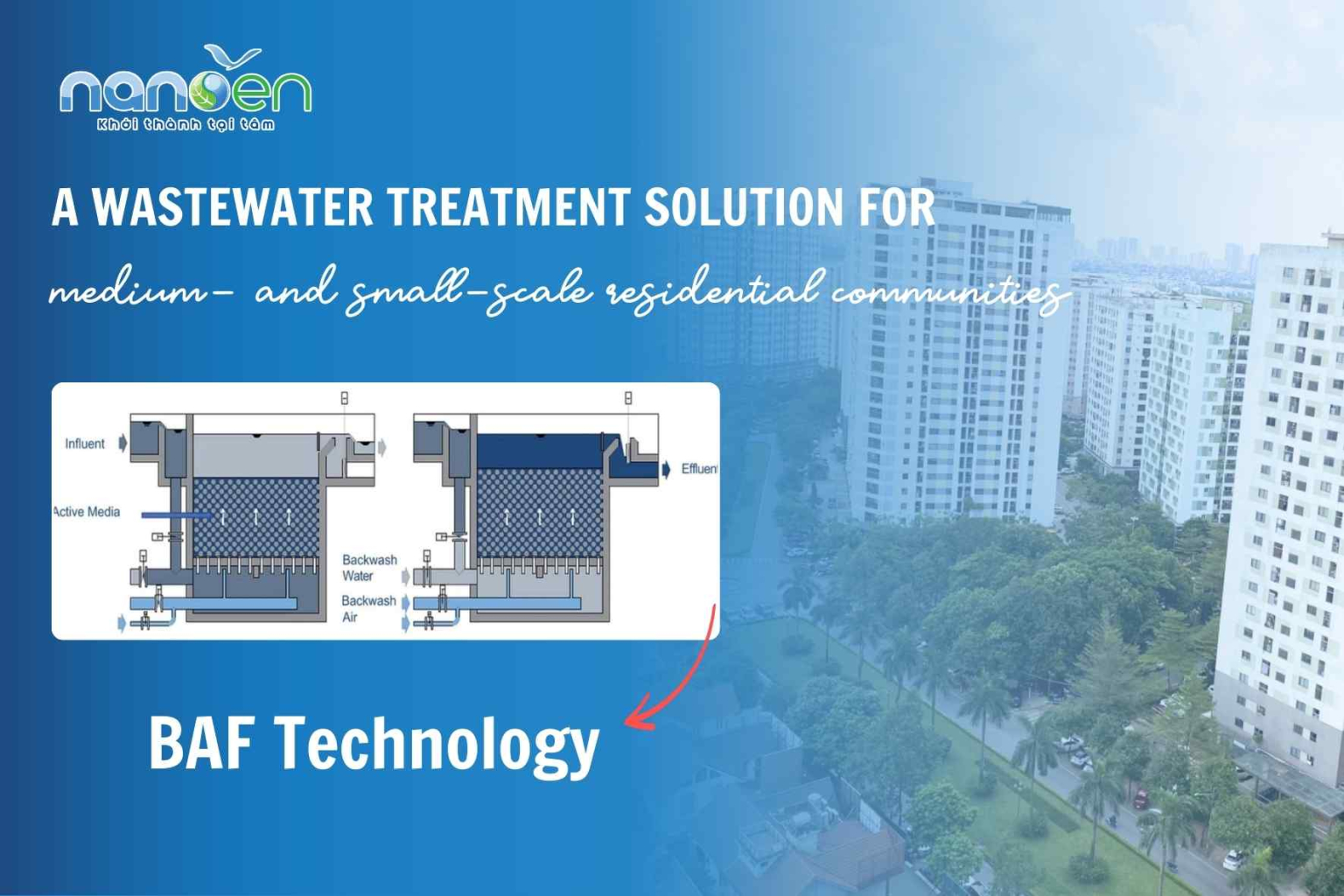
BAF technology (Biological Aerated Filter) is a wastewater treatment solution based on the activity of aerobic microorganisms attached to filter media that are continuously aerated. These microorganisms oxidize and biologically degrade organic pollutants, thereby effectively purifying the wastewater. In the past, filter media typically consisted of gravel; however, they have now been replaced by expanded clay media with particle sizes of 3–5 mm or plastic media, which are both durable and provide an optimized specific surface area for microbial attachment.
The BAF reactor is structurally similar to an upflow water filter and is equipped with an aeration system. This type of reactor is used for biochemical oxygen demand (BOD) removal, as well as for combined BOD removal and nitrification, or stand-alone nitrification in wastewater treatment systems.

This technology not only delivers high efficiency in the treatment of both organic and inorganic pollutants, but also stands out for its low operating costs, low energy consumption, ease of maintenance, and environmental friendliness, making it suitable for medium- and small-scale centralized wastewater treatment systems.
Operating Principles and Biological Mechanisms of BAF Technology
One of the key advantages of BAF technology is the formation of a biofilm on the surface of the filter media. Microorganisms attach to the media and develop a stable biofilm, which is less prone to detachment compared to suspended biomass. As a result, the sludge generated in the settling tank mainly originates from detached biofilm fragments. These fragments are characterized by relatively large particle size, good settleability, and do not significantly increase the sludge loading on the secondary clarifier. Consequently, the sedimentation process becomes more efficient and stable.

BAF tank (illustration)
When the biofilm becomes sufficiently thick, diffusion phenomena occur, in which nutrients and dissolved oxygen (DO) diffuse gradually from the outer layer into the inner layers of the biofilm. In the deeper layers, the concentrations of nutrients and DO decrease, creating anoxic or anaerobic microzones. This provides a significant advantage: denitrification can take place directly within the biofilm structure, resulting in more effective nitrogen removal compared to suspended microbial systems such as conventional activated sludge.
However, strict control of DO concentration in the reactor is required:
- DO must be maintained at a level high enough to allow diffusion into the biofilm, while the biofilm itself must develop to sufficient thickness to form a transition zone, where DO is maintained at > 0 and < 1 mg/L. This range represents the optimal condition for anoxic bacteria to carry out denitrification.
- If DO levels are too high (typically > 1 mg/L), oxygen will penetrate deeper into the biofilm, eliminating anoxic conditions and inhibiting the denitrification process. Therefore, maintaining DO at an optimal range is a critical factor enabling BAF technology to achieve both effective BOD removal and efficient nitrogen removal.
Comparison Between BAF Technology and Other Treatment Technologies
To obtain a comprehensive perspective, it is necessary to compare BAF technology with other commonly applied biological wastewater treatment technologies.
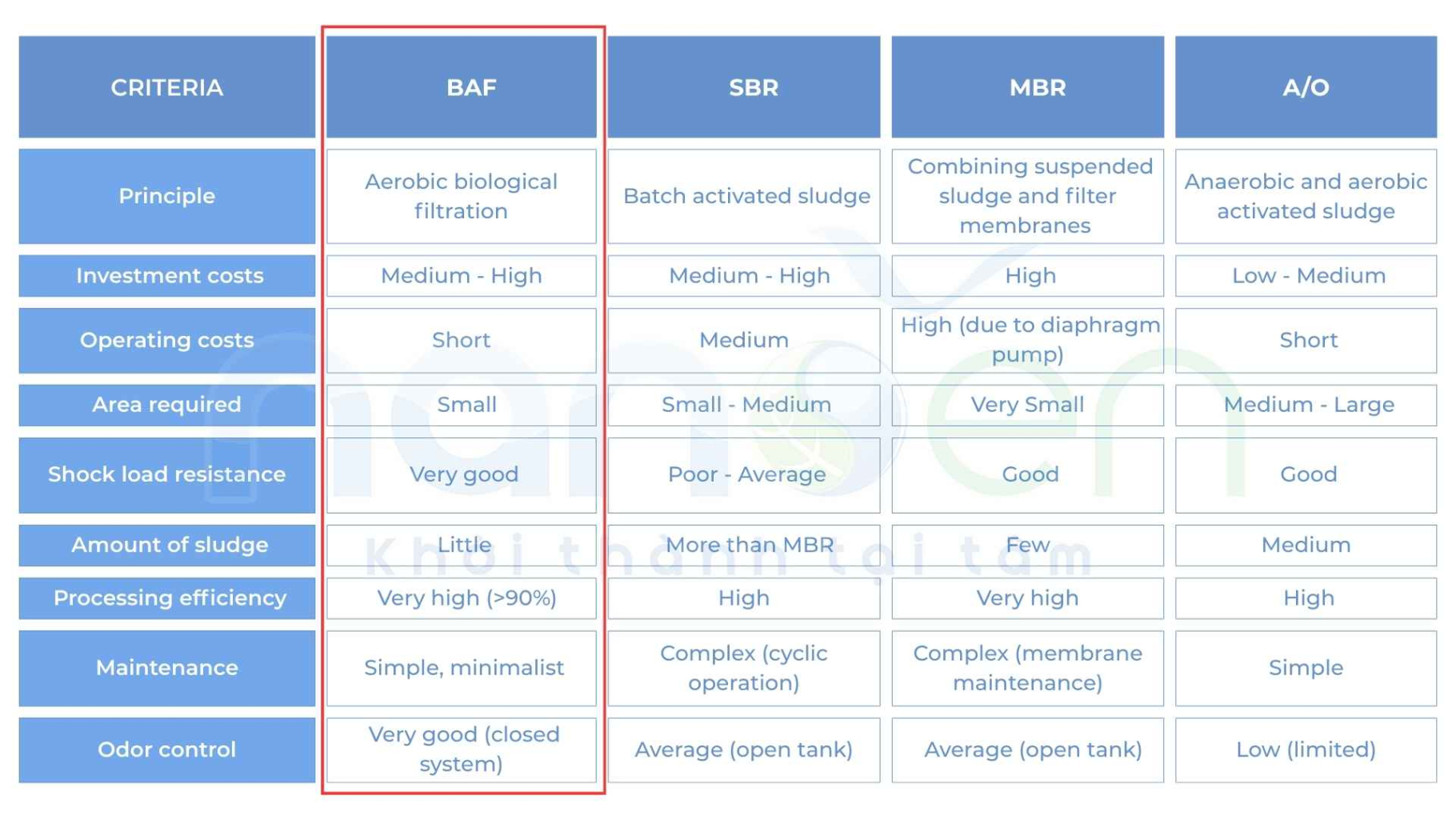
Practical Applications of BAF Technology for Medium- and Small-Scale Domestic Wastewater Treatment in Residential and Apartment Areas
Considering the characteristics of domestic wastewater and the requirements of small-scale projects, BAF technology demonstrates several outstanding advantages, including:
-
Space saving: This is one of the most significant advantages of BAF technology. In urban areas where land availability is limited and land costs are high, the ability of BAF systems to achieve effective treatment with a small footprint becomes a decisive factor. This allows wastewater treatment plants to be integrated directly into building basements or other confined spaces.
-
High efficiency and operational stability: Domestic wastewater exhibits temporal variability, with fluctuating peak and low flow rates. BAF systems are well suited for treating low-strength wastewater and have been proven to maintain high operational stability, enabling effective performance even under varying hydraulic and organic loading conditions.
-
Simple operation: BAF systems are considered easy to operate, which is a critical advantage for small-scale treatment facilities that typically do not have dedicated operation engineers on a 24/7 basis. This simplicity helps reduce labor costs and optimize overall system performance.
However, to ensure stable operation of BAF technology, operators are required to carry out regular monitoring and maintenance, including:
-
Maintenance: Mechanical filter media should be cleaned regularly and washed using treated wastewater from the system to avoid killing beneficial microorganisms. Biological filter media should be periodically inspected and cleaned to ensure that clogging does not occur.
-
Operational monitoring: Key parameters must be continuously monitored, including pressure (to detect potential clogging), flow rate, and critical water quality parameters such as BOD, COD, pH, DO, nitrogen (N), and phosphorus (P).
From BAF Technology to Sustainable Operational Capacity of the Project
BAF technology has demonstrated its ability to effectively meet the key requirements of wastewater treatment systems for residential and apartment developments, including high treatment efficiency, space saving, reasonable operating costs, and stability under fluctuating loading conditions. These advantages make BAF a preferred option for apartment complexes, concentrated residential areas, and small- to medium-sized enterprises.
However, the actual performance of any technology—including BAF—depends heavily on the quality of design, operation, maintenance, and monitoring. Managing risks such as filter media clogging, DO control, shock load response, and optimization of backwashing cycles requires well-defined procedures and practical operational skills.
For project owners and facility operators, investing in operational capacity not only minimizes unexpected costs but also enhances system lifespan, operational stability, and compliance with environmental regulations.
To bridge the gap between technological potential and sustainable field operation, Nanoen provides a Specialized Operator Training Program, designed in practical, modular formats, including:
-
Fundamental theory of BAF and comparative technologies;
-
Daily operation guidelines;
-
Maintenance procedures, including backwashing and clogging mitigation;
-
Monitoring of operational parameters (BOD, COD, DO, flow rate).
The training program is accompanied by competency certification, operation manuals, and personalized consultation tailored to each project.
See also: Operational training tailored to business needs
If your organization is considering the application of BAF technology for a residential or apartment wastewater treatment project, please contact Nanoen for a free consultation. Our team is ready to provide in-depth technical advice, propose a tailored operator training program, and support the planning of pilot testing and on-site operational trials.
Nanoen
NANO ENVIRONMENT TECHNOLOGY - CONSTRUCTION LIMITED LIABILITY COMPANY
Address: 661E/29 Vo Van Kiet, Long Tuyen Ward, Can Tho City, Can Tho
Hotline: 0941.777.519 - 0907.803.678 - 0901.229.798
Email: nanoentech@gmail.com
Facebook: www.facebook.com/nanoentech