

Characteristics of Exhaust Gases and Odor Emissions from By-product Processing Facilities
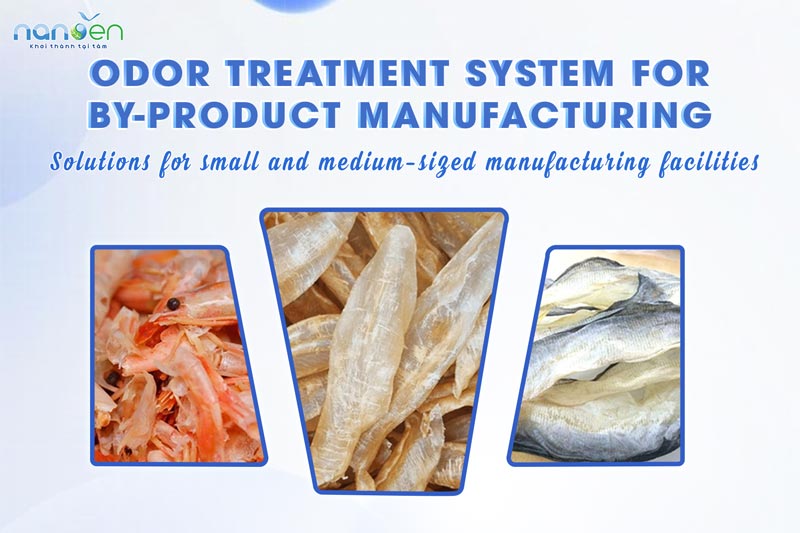
Facilities processing agricultural, aquatic, and seafood by-products commonly generate exhaust gases with strong, fishy, and unpleasant odors. The main components of these emissions typically include:
-
Volatile Organic Compounds (VOCs): generated during the decomposition of raw materials.
-
Hydrogen sulfide (H₂S): characterized by a typical rotten-egg odor.
-
Ammonia (NH₃): pungent, irritating odor that can cause respiratory discomfort.
These gaseous pollutants not only cause discomfort to workers but also pose serious impacts on surrounding residential communities, particularly in small-scale production areas interspersed with residential zones, peri-urban areas, or industrial clusters.
In practice, many facilities still rely on manual or rudimentary measures, such as:
-
Covering odor-generating areas with tarpaulins or enclosures;
-
Natural ventilation or the use of industrial exhaust fans.
However, these methods only provide partial odor reduction and cannot achieve effective treatment, especially in enclosed environments such as processing workshops, drying rooms, or wastewater treatment areas.
In some cases, simple local exhaust systems are installed; nevertheless, such systems often fail to comply with current environmental standards. Therefore, the adoption of modern and effective industrial odor treatment solutions has become an urgent requirement for production facilities today.
Challenges in Odor Treatment for Small-Scale Facilities
In addition to the persistent odor issues that impact the surrounding environment, small- and medium-scale by-product processing facilities face a range of additional challenges, including:
- Limited installation space
Most small- and medium-scale by-product workshops do not have dedicated areas for bulky exhaust gas treatment systems. Installing additional equipment is often difficult because production spaces have already been optimized to the maximum extent.
- Insufficient capital for conventional treatment systems
Industrial odor treatment systems such as biofilters, adsorption towers, or wet scrubbers require relatively high investment costs, which often exceed the initial financial capacity of small facilities.
- Unexpected inspections without feasible solutions
Many workshops are subject to sudden environmental inspections and are required to mitigate odor emissions within a short timeframe. However, due to limited budgets and long construction or installation periods, large-scale treatment systems cannot be deployed in time.
Integrated Odor Control and Treatment Solutions
Odor control should be designed as an integrated system, encompassing collection, treatment, and emission prevention. Instead of applying temporary measures such as enclosure or chemical deodorant spraying, a comprehensive solution is required to eliminate odor at its source, ensure long-term effectiveness, and fully comply with environmental standards.
One of the most effective odor treatment technologies for small- and medium-scale production facilities is a closed-loop odor treatment system combining Ozone and UV technologies. This solution enables root-cause odor removal, delivers stable long-term performance, and meets applicable environmental regulations.
Under specific conditions such as fish sauce production, where exhaust gases contain high concentrations of volatile organic compounds (VOCs) and weak acidic gases, the combination of Ozone and UV is considered an optimal solution due to the following advantages:
-
No heat application, ensuring no alteration of product properties;
-
No generation of secondary pollutants;
-
Immediate effectiveness upon first contact;
-
Easy scalability when production capacity is expanded.
The exhaust gas treatment process using Ozone combined with UV technology typically includes the following main steps:
-
Exhaust gas collection:Exhaust gases are captured from emission sources such as factories, processing workshops, or wastewater treatment areas and conveyed to the treatment system.
-
Pre-treatment (optional):Dust, simple gases, or moisture are removed using filters, absorption towers, or wet scrubbers.
-
Water reuse (if applicable):Spray systems are used for preliminary dust removal and dissolution of certain gases; the collected water is then recovered and reused.
-
UV irradiation:UV lamps (UVC) installed in the reaction chamber directly irradiate the gas stream, disinfecting microorganisms and breaking down organic compounds.
-
Ozone generation and oxidation reaction:Ozone is generated by UV radiation or supplemented by ozone generators, oxidizing remaining pollutants and enhancing overall treatment efficiency.
-
Clean gas discharge:Treated exhaust gas that meets environmental standards is discharged to the atmosphere through the exhaust fan system.
To achieve optimal treatment efficiency and cost savings, production facilities should isolate odor-generating areas to enable effective source control. If exhaust gases are allowed to disperse into the surrounding environment, treatment efficiency will be significantly reduced.
The combined Ozone–UV technology is widely applied across various sectors, including:
-
Industrial sector: Treatment of exhaust gases from rubber manufacturing, chemical production, pharmaceuticals, printing ink, coatings, oil refining, coking processes, and wastewater treatment facilities.
-
Healthcare sector: Air disinfection in operating rooms, isolation wards, and clean rooms.
-
Agriculture: Air and water disinfection in greenhouses, livestock, and poultry farms.
-
Odor control: Removal of unpleasant odors at landfills, food processing plants, industrial kitchens, and municipal solid waste treatment systems.
For small- and medium-scale production facilities, odors generated during processing activities not only affect the working environment but also create barriers to business expansion and brand reputation development.
Nano Environmental Company – Provider of Efficient, Cost-Effective Odor Treatment Solutions Compliant with Environmental Standards
Nanoen specializes in the design and installation of industrial odor treatment systems applying closed-loop Ozone–UV technology, ensuring high treatment efficiency, stable operation, and suitability for a wide range of production sectors.
With a team of highly qualified engineers, Nanoen is committed to delivering optimal technical solutions, transparent cost structures, and long-term support throughout the entire system operation lifecycle.
For detailed technical consultation and a customized quotation tailored to your specific requirements, please contact our hotline: 0941 777 519 - 0901 229 798 - 0907 686 717
Nanoen
NANO ENVIRONMENT TECHNOLOGY - CONSTRUCTION LIMITED LIABILITY COMPANY
Address: 661E/29 Vo Van Kiet, Long Tuyen Ward, Can Tho City, Can Tho
Hotline: 0941 777 519 - 0901 229 798 - 0907 686 717
Email: nanoentech@gmail.com
Facebook: www.facebook.com/nanoentech