

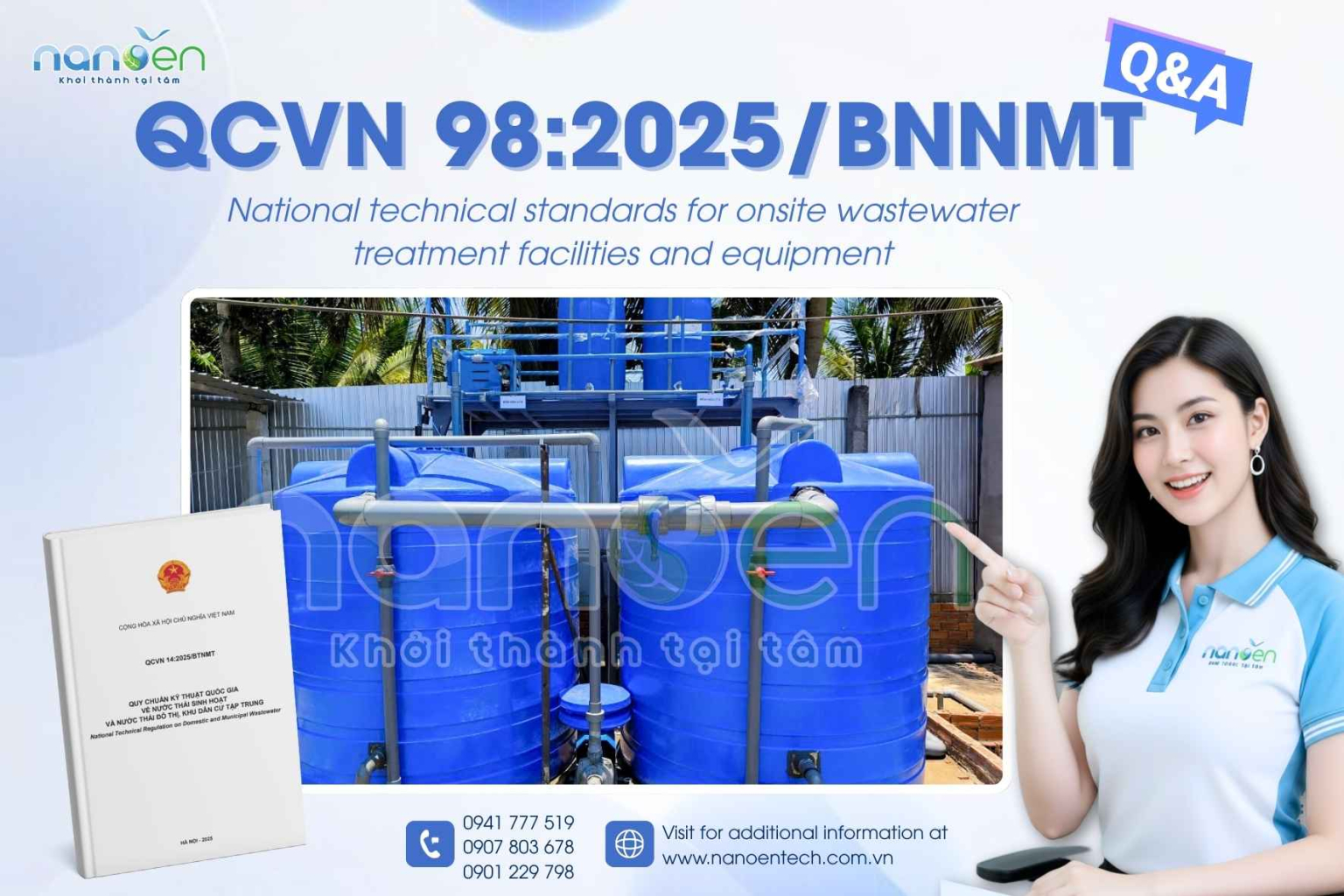
In response to the above situation, the Ministry of Agriculture and Environment issued QCVN 98:2025/BNNMT – National Technical Regulation on On-site Wastewater Treatment Facilities and Equipment, aiming to strengthen the management of small-scale and decentralized wastewater treatment systems.
The regulation will come into effect on 26 February 2026 and serves as a mandatory legal basis for the design, manufacture, construction, installation, operation, maintenance, and servicing of on-site wastewater treatment facilities and equipment. Its implementation contributes to pollution control and environmental protection in areas not yet served by centralized wastewater treatment systems.
QCVN 98:2025/BNNMT focuses on enhancing treatment efficiency at the source, providing detailed requirements on design, materials, safety, operation, and specifying limit values for different treatment capacities.
Scope and Applicable Entities of QCVN 98:2025/BNNMT
According to QCVN 98:2025/BNNMT, the regulation applies to:
-
State management authorities in charge of environment, construction, science, and technology;
-
Organizations and individuals involved in the design, manufacture, construction, installation, operation, and maintenance of on-site wastewater treatment facilities or equipment;
-
Entities generating domestic wastewater as regulated under the Law on Environmental Protection 2020, including:
-
Household-scale production, business, and service establishments (Clause 3, Article 53);
-
Craft village production facilities and households (Clause 2, Article 56);
-
Organizations and individuals managing parks, recreational areas, commercial and service zones, markets, railway stations, bus terminals, ports, ferry terminals, and other public areas (Clause 2, Article 59);
-
Households and individuals with sanitation facilities (Point e, Clause 1, Article 60);
-
Organizations and individuals managing cultural heritage sites, tourist attractions, accommodation facilities, training venues, performance and sports competition facilities, and event organizers (Clause 1, Article 66).
-
Key Definitions under QCVN 98:2025/BNNMT
-
Domestic wastewater: Wastewater generated from bathing, sanitation, food preparation, laundry, or similar activities arising from service-based business operations.
-
On-site wastewater treatment: The treatment of domestic wastewater within the premises of an organization or individual generating such wastewater.
-
On-site wastewater treatment facility: A structure constructed on-site to treat domestic wastewater in compliance with environmental protection requirements under QCVN 98:2025/BNNMT.
-
On-site wastewater treatment equipment: Prefabricated, integrated equipment manufactured for treating domestic wastewater in accordance with QCVN 98:2025/BNNMT.
Key Differences Between QCVN 98:2025/BNNMT and QCVN 14:2025/BTNMT
The introduction of QCVN 98:2025/BNNMT marks a new regulatory approach to domestic wastewater management, particularly for small-scale, decentralized on-site treatment systems. This has led many investors and enterprises to question how it differs from QCVN 14:2025/BTNMT, as both regulations address domestic wastewater.
In practice, each regulation is developed for different management objectives and target groups. Proper understanding and distinction between QCVN 98:2025/BNNMT and QCVN 14:2025/BTNMT are essential not only for selecting appropriate technical solutions but also for ensuring legal compliance and avoiding errors in system design, operation, and commissioning.
| Criteria | QCVN 14:2025/BTNMT | QCVN 98:2025/BNNMT |
|---|---|---|
| Scope | Domestic and municipal wastewater, centralized residential areas | On-site domestic wastewater treatment facilities |
| Technical control | More stringent, controls a wider range of parameters | Focuses on key parameters only |
| Applicable sources | Centralized domestic and municipal wastewater, including service activities (hotels, restaurants, healthcare, schools, apartments, markets, parks, etc.) | On-site domestic wastewater generators: individual houses, household-scale businesses, craft villages, tourist areas, parks, markets, and public spaces |
QCVN 98:2025/BNNMT allows significantly more flexible effluent limits for small-scale treatment systems, reducing the investment burden associated with complex treatment technologies.
It also clarifies technical requirements such as impermeability, odor control, minimum free volume (≥20% of tank volume), and sludge storage capacity for at least one year, ensuring sustainable operation without imposing the stringent discharge standards of QCVN 14:2025/BTNMT from the outset.
Frequently Asked Questions (FAQs)
1. What issue does QCVN 98:2025/BNNMT address?
It regulates on-site, small-scale domestic wastewater treatment facilities and equipment, standardizing requirements from design and installation to operation and management, rather than focusing solely on effluent quality.
2. Do QCVN 98 and QCVN 14 overlap?
No. According to Section 1.2.2 of QCVN 14:2025/BTNMT, it does not apply to entities using on-site wastewater treatment facilities regulated under environmental protection laws.
3. What are the effluent standards under QCVN 98:2025/BNNMT?
Depending on system capacity:
-
< 2 m³/day: BOD₅ ≤ 130 mg/L; COD ≤ 200 mg/L; TSS ≤ 120 mg/L
-
2 to < 20 m³/day: BOD₅ ≤ 60 mg/L; COD ≤ 100 mg/L; TSS ≤ 70 mg/L; Total N ≤ 40 mg/L; Total P ≤ 8 mg/L
-
≥ 20 m³/day: Must comply with QCVN 14:2025/BTNMT
4. How should on-site treatment systems be maintained?
They must be operated and maintained periodically according to the designer/installer’s instructions, including equipment inspection, scheduled sludge removal, and timely troubleshooting.
5. What does QCVN 98:2025/BNNMT focus on controlling?
- Technical requirements for facilities and equipment
- Safety, durability, and operational stability
- Compatibility with wastewater generation scale
- Prevention of secondary pollution risks
6. What risks arise from applying the wrong regulation?
-
Rejection during inspection or acceptance
-
Required retrofitting after installation
-
Increased investment and operating costs
-
Project delays affecting business operations
7. How does QCVN 98 benefit small-scale businesses?
-
Clear basis for selecting suitable treatment solutions
-
Reduced investment costs
-
Improved transparency in environmental management
8. How should entities ensure proper application of both regulations?
-
Clearly identify whether the system is on-site or centralized
-
Understand the role of each regulation
-
Consult experienced environmental consultants
-
Ensure consistency between design, operation, and environmental documentation
Nanoen – Integrated Environmental Consulting and Compliance Support
Proper understanding and application of regulations such as QCVN 98:2025/BNNMT and QCVN 14:2025/BTNMT are not only legal compliance requirements but also the foundation for selecting suitable technical solutions and achieving long-term, stable wastewater treatment performance.
With extensive practical experience in environmental legal consulting, wastewater treatment system operation, and environmental documentation, Nanoen supports enterprises from initial assessment and regulatory selection to system operation and completion of environmental reports in full compliance with regulatory requirements.
This integrated approach helps businesses mitigate legal risks, optimize operating costs, and ensure compliance from the outset.
Reliable and Efficient Environmental Services in the Mekong Delta
Nano Environment Technology – Construction Limited Liability Company (Nanoen) is a trusted provider of professional environmental services in the Mekong Delta region. Over the years, Nanoen has earned client confidence through integrity, dedication, and responsibility toward both customers and service quality.
With a team of experienced professionals, Nanoen delivers comprehensive environmental solutions, including environmental permitting and documentation consulting, system design and construction, wastewater treatment system operation, operator training, and supply of microbial products.
Guided by the philosophy “Built from the heart”, every project is implemented with full commitment. Nanoen is dedicated to providing optimal solutions that fully meet enterprise needs.T
Nanoen
NANO ENVIRONMENT TECHNOLOGY - CONSTRUCTION LIMITED LIABILITY COMPANY
Address: 661E/29 Vo Van Kiet, Long Tuyen Ward, Can Tho City, Can Tho
Hotline: 0941.777.519 - 0907.803.678 - 0901.229.798
Email: nanoentech@gmail.com
Facebook: www.facebook.com/nanoentech