

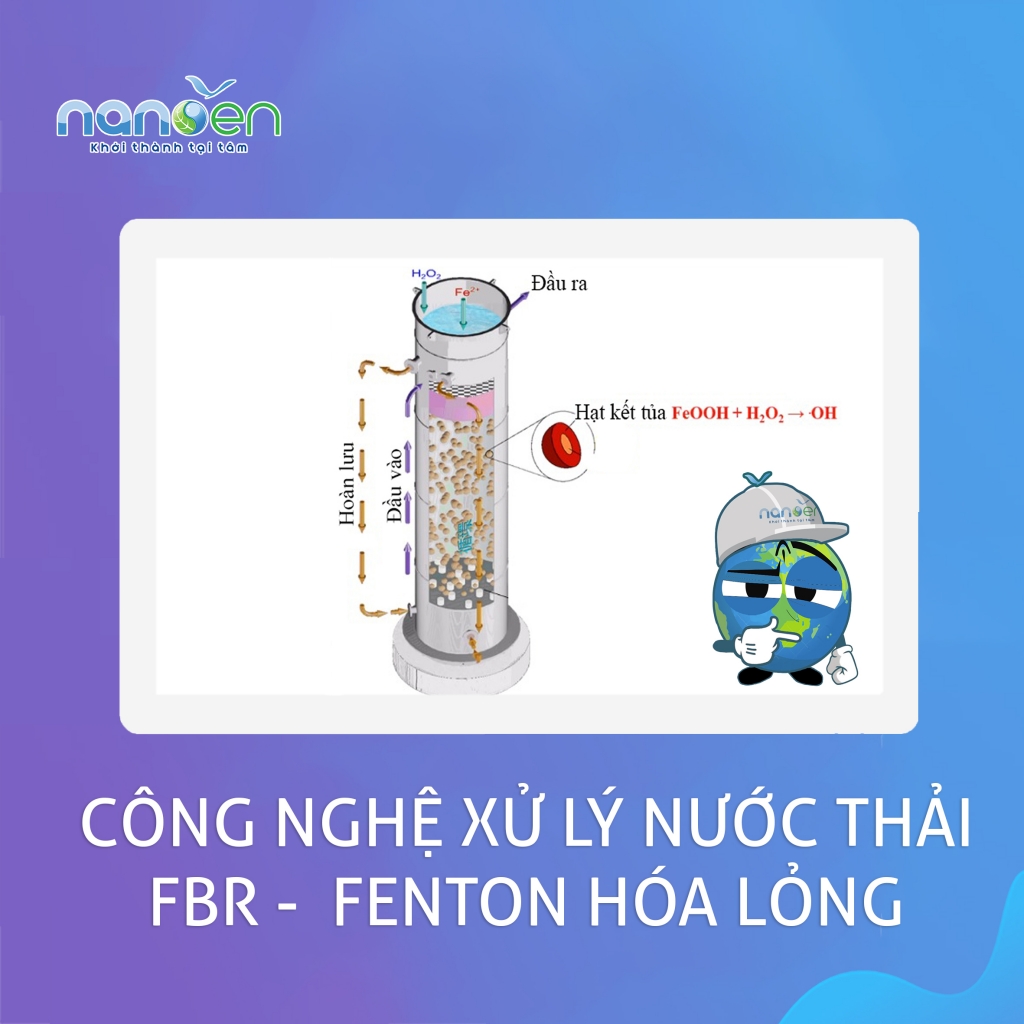
WHAT IS FBR TECHNOLOGY?
Fenton (FBR) is a wastewater treatment technology that mainly uses the oxidation ability of strong oxidants to treat organic substances in water into CO2 and H2O, this is a technology commonly used worldwide in general and in Vietnam in particular.
This technology uses a catalyst, Iron Ion, so that Hydrogen peroxide (H2O2, also known as hydrogen peroxide) oxidizes dissolved organic substances in wastewater. In which, the advanced oxidation process (AOPs, Advance Oxidation Processes) is most effective in producing hydroxyl radicals (•OH, Hydroxyl radicals) - with high oxidation ability, second only to fluorine.
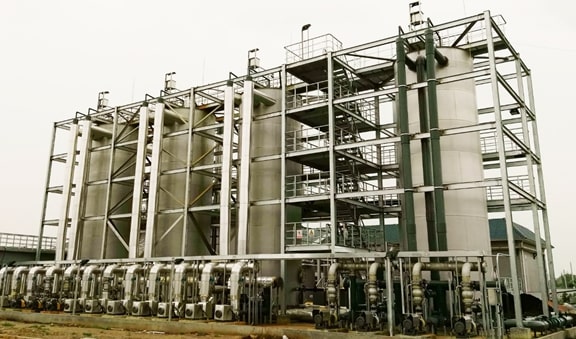
System applies FBR – Fenton technology
However, the traditional Fenton technology has some disadvantages such as high chemical consumption and a large amount of sludge. To overcome these disadvantages, researchers have developed a new, superior form of Fenton treatment technology called liquefied Fenton (FBR – Fenton).
Comparison between traditional Fenton and FBR – Fenton:
| Characteristic | Traditional Fenton | FBR - Fenton |
| Amount of chemicals |
Use a lot of chemicals |
The amount of chemicals needed is reduced by more than 50% compared to traditional Fenton |
| Amount of mud | High sludge volume | Sludge volume reduced by more than 60% compared to traditional Fenton |
| Processing costs | It costs a lot to treat sludge | Save a lot of cost in sludge treatment |
1. Scope of application and handling mechanism
Scope of application:
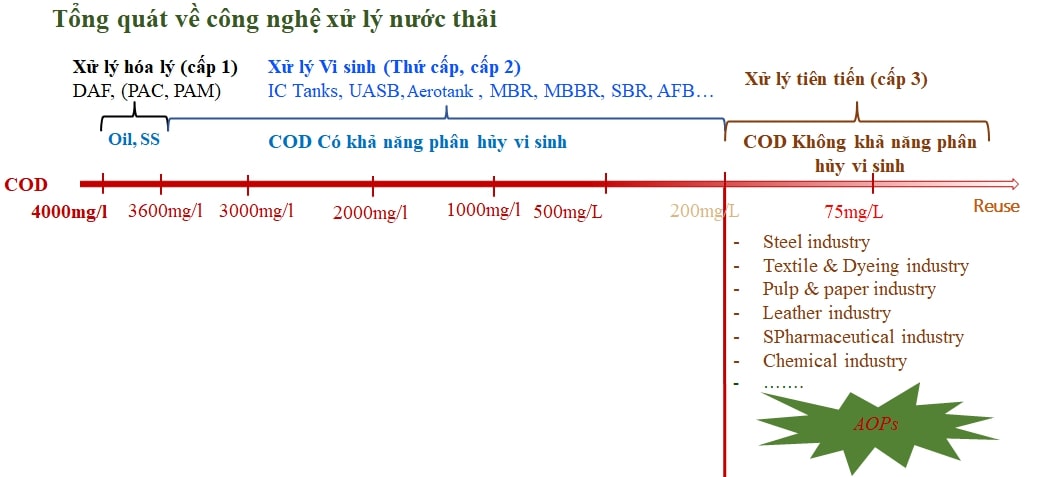
Scope of application of wastewater treatment levels
Processing:
-
Physico-chemical treatment (level 1 treatment): to remove grease, suspended solids, etc. Nowadays, there are popular technologies such as DAF flotation, coagulation-flocculation, precipitation, etc.
-
Secondary microbiological treatment (level 2 treatment): to remove CODs that can be biodegraded, inorganic substances that can affect the oxidation of level 3 treatment.
-
Advanced treatment (level 3 treatment): in this stage, the majority of CODs that cannot be biodegraded are left. To treat these difficult-to-degrade organic substances, it is necessary to use advanced oxidation technology (AOPs - Advance Oxidation Process). Depending on the practical conditions and economic potential of each investor, appropriate oxidation radicals are selected.
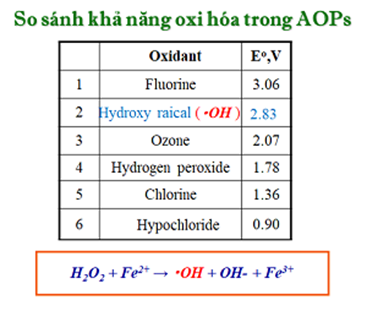
CHC Oxidation Ability Between Different Oxidants.
Đọc thêm: Biological rotating cage technology
2. Wastewater treatment mechanism of traditional Fenton technology
The advantage of traditional Fenton is its ability to strongly oxidize organic substances CODs of the •OH radical produced during wastewater treatment (the ability to oxidize organic substances is extremely high, second only to Florine).
•OH is a non-selective oxidation angle, capable of completely oxidizing organic substances into CO2 and H2O. Below are two reactions that occur in two acidic environments (1) and neutral environments (2):


The process of organic matter decomposition includes 3 reactions: Hydroxylation, Dehydrogenation and Oxidation-Reduction.
It can be simply explained that the Hydroxy reaction process of cyclic organic substances leads to the division of molecules into smaller constituent molecules such as carboxylic fatty acids, dicarboxylic acids (organic acids containing 1 or 2 (-COOH) groups) leading to the accumulation of oxalic acid, formic acid and finally leading to complete mineralization to CO2.
In traditional Fenton, Fe2+ acts as a catalyst which is regenerated by reaction (3):


The reaction between Fe3+ and H2O2 is called the heterogeneous Fenton reaction (the reaction produces HO2). However, HO2 is not a strong oxidant and cannot completely oxidize organic substances. But it has the effect of propagating the Fenton reaction by providing more Fe2+ which is regenerated by reaction (4):


However, one thing to note is that reactions (3) and (4) occur more slowly than reaction (1). This leads to the problem that after the traditional Fenton reaction, all Fe3+ is converted into precipitated Fe(OH)3 sludge.
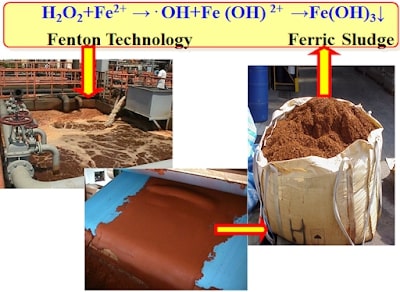

Phản ứng kết tủa bùn sắt
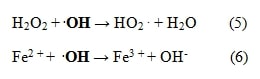
In addition, in the traditional Fenton process, undesirable reactions (5) and (6) also occur. This leads to a reduction in the amount of •OH, weakening the process of organic matter decomposition.

Đọc thêm: USBF - Biological technology combined with upstream sludge filtration
3. Notes when applying Fenton technology
Inorganic ions commonly found in wastewater such as Phosphate, Chlorine and Nitrate are agents that reduce the efficiency of chemical use. Below are the undesirable reactions in Fenton in the presence of inorganic ions:
-
Negative effects influenced by the presence of inorganic ions (in decreasing order):


-
The presence of phosphate leads to precipitation of ferric phosphate, thereby reducing the presence of Fe2+ in the reaction (1).
-
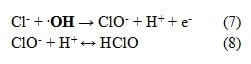
The influence of Cl- (Chloride Ion) has two main causes: one is the chloride complex inhibiting reaction (1), the other is oxidation. More dangerous is leading to the formation of Hypochorite radicals by the reaction between Cl- and •OH:

-
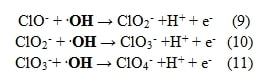
In addition, •OH is also limited by the following reactions:

4. Improved Fenton Technology (FBR – Fenton)
-
Structure and operating principle:
FBR – Fenton technology consists of a vertical cylindrical tank containing wastewater, inside of which there is a carrier. The top of the tank is where the wastewater is pumped in, drained, circulated, and sludge is added, and chemicals are added to the tank.

Structural diagram of FBR - Fenton technology
The basic principle in improved Fenton is to simultaneously perform two reactions, Homogeneous (Fe2+/H2O2) and Heterogeneous (FeOOH/H2O2), instead of one homogeneous reaction like traditional Fenton.
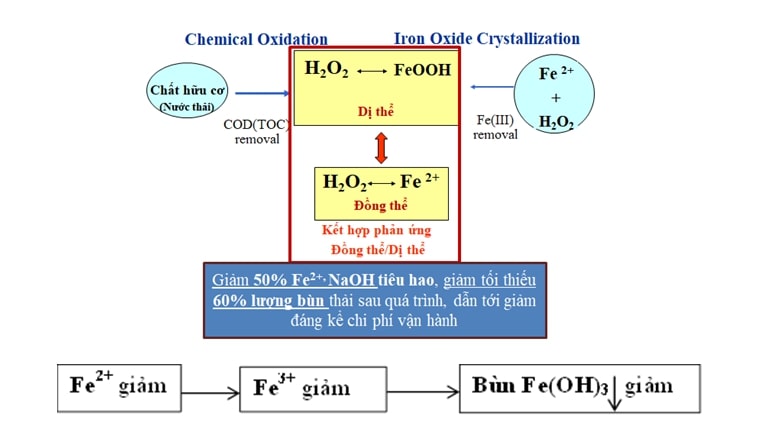
FBR - Fenton treatment diagram
Because two reactions occur at the same time, the amount of Fe2+ used decreases, leading to a decrease in the amount of NaOH used.
5. Advantages and disadvantages of FBR – Fenton
Advantage:
-
High flexibility, treated wastewater has stable quality: during operation, when COD concentration changes, just increase or decrease the amount of Fe2+ and H2O2 chemicals used.
-
Simple operation: the system is automatically controlled, when the wastewater properties change, just need to readjust the amount of chemical supply automatically.Tính oxy hóa mạnh: bằng các nghiên cứu khoa học và kinh nghiệm xử lý đã chứng minh FBR – Fenton có thể xử lý được rất nhiều chất ô nhiễm như BTEX, Chlorobenzen, Aldehyde,…
-
Reduced operating costs: reduced chemical consumption and reduced sludge volume by more than 60% after the process compared to traditional Fenton technology. Up to now, FBR – Fenton has been proven to be one of the most advanced technologies in the world, contributing to saving operating costs when treating wastewater with soluble COD that cannot be biodegraded at low concentrations.
Disadvantages:
-
Difficulty in handling inorganic ions such as Phosphate, Chlorine and Nitrate.
The •OH radical is restricted by Cl- ions, which can inhibit the reaction and form unwanted toxic substances.
6. Application
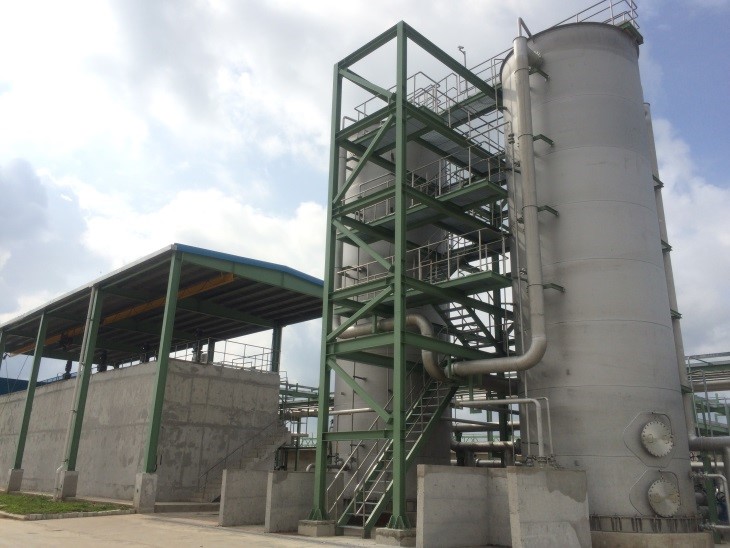
FBR-Fenton technology at Zhengloong Binh Duong paper mill.
(Source: tailieumoitruong.org)
FBR – Fenton technology is applied mostly in factories that generate waste rich in dissolved COD (CODs that cannot be treated biologically or chemically); mainly in industrial production such as textile dyeing, paper industry, chemicals, plating slag, cosmetics, leather and footwear production, pharmaceuticals, etc.
Prestigious unit providing environmental profile services and construction, operation, maintenance - repair of wastewater treatment systems
Nanoen is a unit operating in the environmental field. During its operation, Nanoen has received the trust of customers for its honesty, dedication and responsibility towards customers and the company's products.
With a team of experienced staff, we have a full range of services from environmental profile consulting to construction design, environmental treatment system operation, microbiological supply, sludge pressing for hire...
Nanoen is always ready to bring the best service experience, suitable for the needs of our customers.
Nanoen
Đọc thêm: Air Stripping in wastewater treatment
NANO ENVIRONMENT TECHNOLOGY - CONSTRUCTION LIMITED LIABILITY COMPANY
Address: 661E/29, Vo Van Kiet Street, Binh Yen A Quarter, Long Hoa Ward, Binh Thuy District, Can Tho City
Hotline: 0941.777.519 - 0907.803.678 - 0901.229.798
Email: nanoentech@gmail.com
Facebook: www.facebook.com/nanoentech