

Compared to the Law on Environmental Protection 2020, the recent amendments are not limited to legal and procedural adjustments. They also reflect a broader policy orientation toward stronger decentralization to local authorities, the reduction of formalistic administrative procedures, and higher consistency requirements between legal documentation and actual operational practices.
1. Changes Related to Environmental Impact Assessment (EIA)
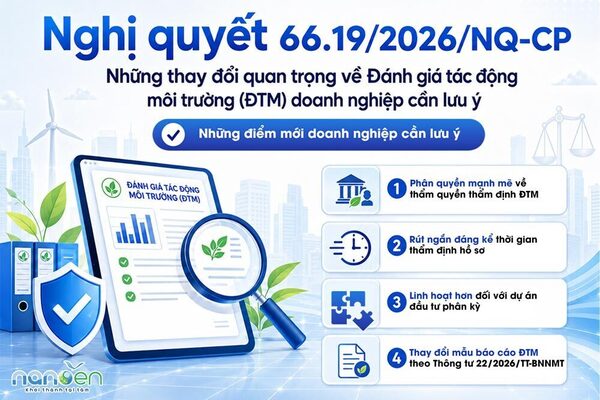
The Law amending and supplementing a number of articles of the Law on Environmental Protection 2025 introduces several notable adjustments to the Environmental Impact Assessment (EIA) framework.
Specifically, the amended Law:
-
Expands the list of projects not required to conduct an EIA;
-
Removes the mandatory requirement to engage a qualified consulting entity to carry out the EIA;
-
No longer rigidly stipulates EIA dossiers, contents, timelines, and appraisal organizations in the Law itself, instead delegating detailed regulations to the Minister of Agriculture and Environment.
These changes demonstrate increased procedural flexibility and greater autonomy for project owners. At the same time, they impose higher expectations regarding the quality and substance of EIA reports, ensuring that assessments accurately reflect the actual conditions, scale, and environmental impacts of each project.
See also: Key updates on Environmental Impact Assessment (EIA) under Law No. 146/2025/QH15
2. Adjustment of Environmentally Sensitive Factors
A significant change under the amended Law is the removal of land used for two or more annual rice crops from the list of environmentally sensitive factors used to classify projects into Group I and Group II.
This adjustment may substantially affect project classification, particularly for investment projects located in agricultural areas, and contributes to a more realistic and context-based environmental risk assessment approach.
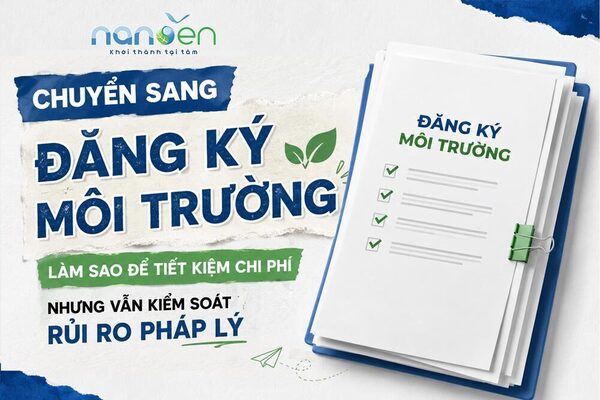
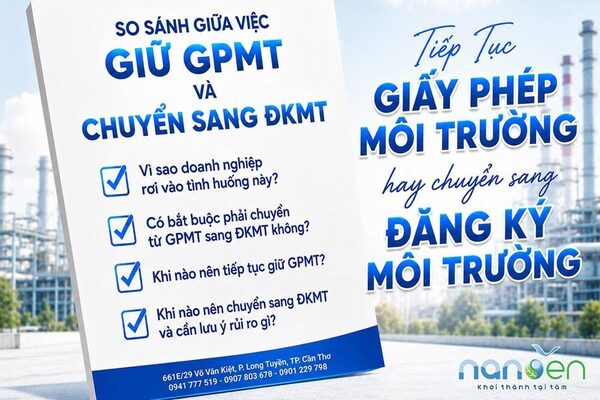
3. Reform of Environmental Permits and Environmental Registration
The amended Law eliminates the procedure for “re-issuance” of Environmental Permits in cases where changes do not alter the fundamental nature of a project, such as changes in the project owner’s name or other administrative information.
Under the new regulations, such changes are to be integrated into periodic environmental protection reports, rather than requiring a separate administrative procedure.
In addition, the Law:
-
Further decentralizes authority to provincial-level People’s Committees for appraisal and issuance of Environmental Permits for certain project types;
-
Replaces the term “exempt from environmental registration” with “objects not required to carry out environmental registration.”
While these reforms simplify administrative procedures, they also require enterprises to be more proactive in managing, updating, and maintaining their environmental documentation.
4. Environmental Protection Requirements for Concentrated Production, Business and Service Areas and Industrial Clusters
The amended Law supplements and clarifies various provisions regarding environmental protection responsibilities in concentrated production, business and service areas and industrial clusters (ICs).
Key updates include:
-
Allowing these areas to use shared centralized wastewater treatment systems, in line with practical conditions in many localities;
-
Clearly defining the responsibilities of infrastructure investors and secondary facilities in wastewater connection, collection, and treatment;
-
Assigning provincial-level People’s Committees the responsibility to issue plans and roadmaps for investing in environmental protection infrastructure, or to decide on exemptions in specific cases.
For existing industrial clusters, the amended Law also adjusts requirements regarding the timeline for completing environmental protection infrastructure, making them subject to provincial-level plans and decisions, rather than applying a uniform national deadline as before.
5. Reform of Environmental Inspection and Enforcement Activities
The amended Law continues to refine inspection and enforcement mechanisms with the objectives of:
-
Improving regulatory effectiveness;
-
Reducing overlap and duplication that may disrupt lawful production and business activities.
A notable new provision allows for unannounced inspections in cases where there is evidence suggesting that regulated entities may conceal violations or destroy relevant documents.
At the same time, the Law emphasizes that specialized inspections must avoid unnecessary interference with normal business operations and prevent duplication among regulatory authorities.
Overall Assessment and Implications for Enterprises
Overall, the amended Law reflects a clear shift from procedure-based management to process- and responsibility-based management. While the new regulations provide greater flexibility in implementation, they also require project owners and operating facilities to fully understand and strictly comply with their environmental protection obligations.
For enterprises, timely understanding of these legal updates is essential—not only to ensure compliance, but also to proactively prepare for necessary adjustments related to environmental documentation, technical solutions, and environmental management practices in the coming period.
Reliable and Professional Environmental Consulting Services in the Mekong Delta
Nanoen is a professional environmental consulting firm with a strong reputation built on integrity, dedication, and responsibility toward clients and service quality.
In addition to providing comprehensive environmental consulting packages, Nanoen also specializes in:
-
Design and construction of environmental treatment systems
-
Operation and maintenance of environmental treatment systems
-
Supply of biological treatment products
-
Customized training for wastewater treatment system operation
We are committed to delivering optimal and practical solutions that fully meet the operational and compliance needs of enterprises.
Nanoen
NANO ENVIRONMENT TECHNOLOGY - CONSTRUCTION LIMITED LIABILITY COMPANY
Address: 661E/29 Vo Van Kiet, Long Tuyen Ward, Can Tho City
Hotline: 0941.777.519 - 0907.803.678 - 0901.229.798
Email: nanoentech@gmail.com
Facebook: www.facebook.com/nanoentech