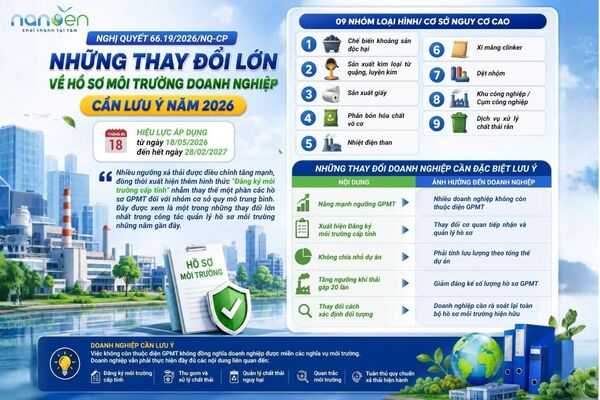


These regulatory shifts impact not only new investment projects but also operating enterprises planning to expand scale, adjust capacity, modify technologies, or upgrade waste treatment systems.
What key aspects should businesses consider when implementing projects under these new regulations?
Let’s explore the critical changes in EIA regulations with Nanoen to proactively manage investments, project expansions, and environmental compliance in accordance with the new statutory requirements.
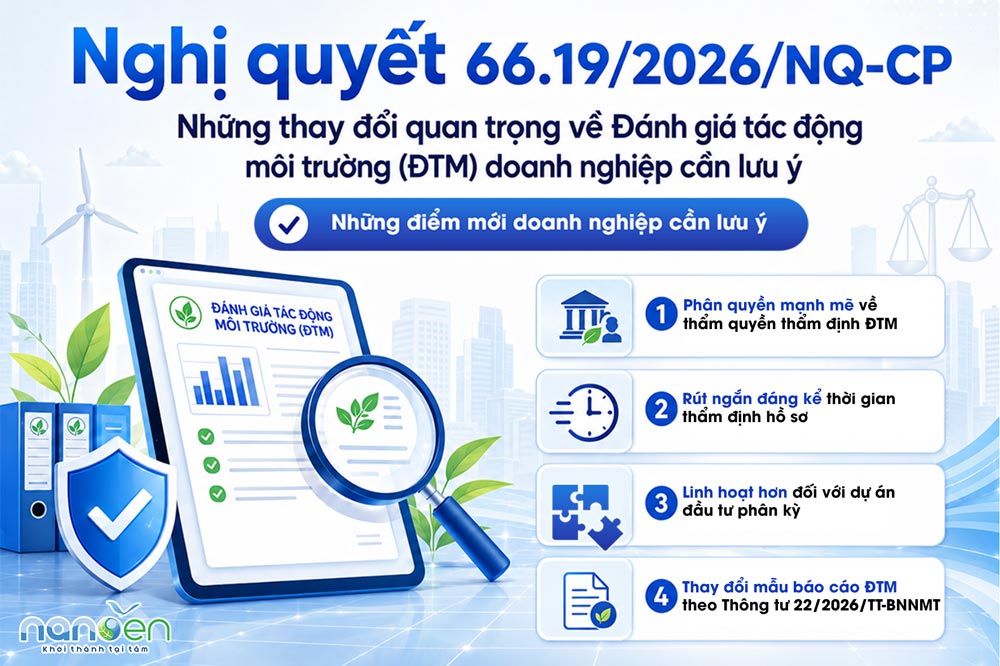
1. Robust Decentralization of EIA Appraisal Authority
One of the most profound updates in Resolution 66.19/2026/NQ-CP is the extensive decentralization of authority to local governments in appraising EIA reports.
Previously, pursuant to the Law on Environmental Protection 2020 and its guiding documents, the Ministry of Agriculture and Environment held the appraisal authority over numerous Group I projects or projects subject to investment policy approval by the National Assembly and the Prime Minister.
Under the new decree, however, the majority of investment projects are now delegated to the Chairpersons of provincial-level People's Committees for appraisal and approval.
The Ministry of Agriculture and Environment retains jurisdiction over only a limited number of specialized projects with high environmental sensitivity or substantial potential environmental risks, including:
-
Nuclear power plant projects and research nuclear reactors;
-
Projects involving land use within nature reserves, special-use forests, or environmentally sensitive areas;
-
Sea reclamation projects;
-
Mining and mineral extraction projects;
-
Certain large-scale projects or those categorized under industries with a high risk of environmental pollution.
This delegation significantly alleviates the administrative burden on central authorities while empowering local governments to expedite investment procedure processing.
2. Significant Reduction in Dossier Appraisal Timeline
Alongside decentralization, Resolution 66.19/2026/NQ-CP considerably shortens the timeline for EIA dossier appraisal to facilitate faster project execution for businesses.
EIA Appraisal and Processing Timelines:
-
Ministry of Agriculture and Environment, Ministry of National Defence, Ministry of Public Security: Not exceeding 30 days.
-
Chairperson of Provincial-level People's Committee: Not exceeding 20 days.
-
Special Public Investment Projects: Not exceeding 10 days.
Compared to previous regulations (which stipulated up to 45 days for Group I projects and 30 days for Group II projects), the processing window has been substantially reduced. This offers a major advantage for enterprises, particularly those in the pre-investment phase or seeking to accelerate deployment schedules to meet business and production targets.
3. Enhanced Flexibility for Phased Investment Projects
In practice, many projects are executed in multiple phases rather than fully developed from the outset. Previously, formulating EIA reports for such phased projects often encountered various regulatory hurdles.
Under the new regulations, project proponents are entitled to choose between:
-
Preparing a comprehensive EIA report for the entire project; or
-
Preparing separate EIA reports tailored to each investment phase.
For phased reporting, the EIA report of subsequent phases must inherit and update the contents approved in the preceding phases. The new approval decision will supersede prior decisions to ensure regulatory consistency across the management process.
However, it is crucial to note that the environmental criteria used to classify the project must still be assessed based on the total overall scale of the entire project. This safeguard prevents the fragmentation of projects into minor phases to circumvent environmental obligations or evade necessary legal procedures.
4. Implementation of the New EIA Report Template under Circular 22/2026/TT-BNNMT
In addition to updates on authority and timelines, another noteworthy change is the replacement of Form No. 04 in Appendix II of Circular 02/2022/TT-BTNMT with Form No. 04 in Appendix V of Circular 22/2026/TT-BNNMT.
This administrative adjustment reflects a strategic shift in environmental impact assessment methodology rather than a mere structural format update. While various conventional sections have been streamlined, new requirements have been integrated to enhance the assessment of impacts on local livelihoods, water resources, and biodiversity.
Key updates are highlighted in the table below:
| Section | Key Amendments |
| Socio-Economic Conditions |
Focuses directly on affected target groups such as households and production facilities subject to land, surface water, or marine area acquisition. Requires explicit assessments of livelihoods, local customs, culture, religion, and related social factors. |
| Impact Assessment on Local L livelihoods |
Incorporates a specialized database to evaluate livelihood impacts and establishes concrete frameworks for support, compensation, or resettlement in subsequent chapters. |
| Data Sources for Assessment |
Increases the stringent requirements for field surveys in areas sensitive to biodiversity and water resources to elevate the reliability of the report. |
Critical Compliance Considerations for Businesses
Circular 22/2026/TT-BNNMT demonstrates that regulatory bodies are moving beyond a singular focus on pollution sources to take a more holistic view of the social and natural resource impacts of projects.
Projects involving the following activities will face a significantly increased volume of fieldwork and baseline surveying in Chapter 2 compared to past practices:
-
Acquisition of land or surface water from local residents;
-
Dredging, backfilling, or reclamation of rivers and lakes;
-
Appropriation of marine areas;
-
Proximity to special-use forests, nature reserves, or wetlands.
Therefore, enterprises must promptly review project locations and environmental sensitivities to compile sufficient baseline data right from the initial stages of EIA formulation, preventing delays caused by regulatory requests for supplementary data during appraisal.
Determining whether a technical modification warrants a completely new EIA requires a concurrent evaluation of engineering specifications, legal parameters, and industry-specific traits. Engaging an experienced environmental consultancy early in the planning phase will mitigate compliance risks, save processing time, and ensure seamless project execution under the latest laws.
Resolution 66.19/2026/NQ-CP represents more than an administrative adjustment; it marks a significant evolution in environmental governance for investment projects. Staying current with these new decrees will enable enterprises to strategically chart their investment roadmaps, mitigate legal liabilities, and optimize project implementation in the upcoming period.
Reputable Environmental Consulting Services in the Mekong Delta
Nanoen is an environmental consulting company with practical experience in implementing numerous projects and supporting businesses in handling environmental legal procedures.
We provide services including environmental documentation consulting, design – construction – operation of treatment systems, as well as training and operational optimization tailored to each business’s actual conditions.
With a long-term partnership approach, Nanoen focuses on delivering suitable solutions that ensure regulatory compliance while optimizing implementation costs.
Contact Nanoen today via HOTLINE 0941 777 519 - 0907 803 678 - 0901 229 798 for consultation and environmental documentation review tailored to your specific case
Nanoen
NANO ENVIRONMENT TECHNOLOGY - CONSTRUCTION LIMITED LIABILITY COMPANY
Address: 661E/29 Vo Van Kiet, Long Tuyen Ward, Can Tho City
Hotline: 0941.777.519 - 0907.803.678 - 0901.229.798
Email: nanoentech@gmail.com
Facebook: www.facebook.com/nanoentech