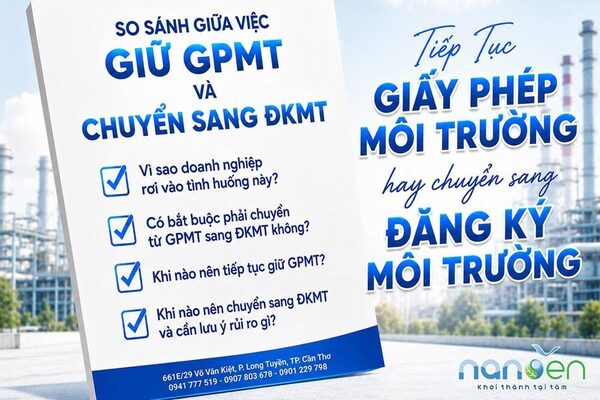



Environmental Registration has become a key focus for many businesses in Vietnam when reviewing their existing environmental compliance records. This is particularly critical as facilities reassess their environmental liabilities to align with the current regulatory framework.
A major question arises for project owners: Should businesses self-prepare the Environmental Registration or hire a professional environmental consultancy?
In reality, there is no one-size-fits-all answer. The most critical factor is not simply "who prepares the document," but whether the registration accurately reflects the facility's actual operations, waste generation sources, environmental treatment systems, and post-registration compliance obligations.
Since businesses understand their daily operations best, their role in providing, verifying, and validating information remains paramount—regardless of whether they self-perform or outsource. Ultimately, the business owners bear the legal liability for the accuracy, integrity, and compliance of the registered content.
Can Businesses Self-Prepare Their Environmental Registration?
Businesses are fully permitted to self-prepare their Environmental Registration if they possess sufficient operational data, internal expertise, and a thorough understanding of their processes.
This internal approach is typically suitable when the enterprise has tight control over its production processes, raw material inputs, waste streams, and existing environmental mitigation facilities. It works best if there are no significant deviations between past environmental paperwork and current operational reality.
However, choosing to self-perform means the internal team must strictly control the accuracy and consistency of the entire submission. The dossier must mirror actual operations to prevent any omissions of waste streams, treatment facilities, or post-registration compliance duties.
From an expert perspective, the greatest risk does not stem from "who writes the report," but from discrepancies between the dossier and actual field conditions.
Common compliance gaps and data discrepancies found during dossier preparation include:
-
Misidentifying the specific project category or the competent regulatory authority.
-
Providing incomplete descriptions of production processes, manufacturing capacities, or raw material consumption.
-
Omitting critical waste generation sources, including industrial wastewater, emissions, solid waste, or hazardous waste.
-
Inaccurately describing wastewater collection networks, air emission treatment systems, or hazardous waste storage areas.
-
Failing to update operational changes or expansions relative to legacy environmental approvals.
-
Lacking technical justification and baseline data when regulatory authorities conduct site inspections.
Therefore, the ultimate question is not whether a business can legally self-perform, but rather: Does the environmental registration dossier truly, accurately, and comprehensively reflect the facility's current operations?
With this context in mind, the decision to self-prepare or seek professional consultancy support should be weighed carefully.
When Should Businesses Consider Professional Environmental Consultancy?
In many scenarios, partnering with an experienced consultant provides businesses with a structured approach to auditing their historical records, especially for complex facilities with extensive data or those that have undergone multiple operational phases.
Businesses should consider external technical support when:
-
Historical environmental approvals were approved many years ago under legacy laws.
-
The facility has experienced changes in production capacity, manufacturing technology, raw materials, final products, or machinery.
-
The facility has modified, upgraded, or expanded its wastewater treatment plants (WWTP), air pollution control systems, or waste storage yards.
-
There are multiple complex waste streams that require rigorous environmental auditing.
-
The internal team is uncertain about their specific regulatory classification, the competent authority, or upcoming environmental monitoring duties.
-
Legacy documents are incomplete, lost, or inconsistent with current site conditions.
-
The business proactively wants to mitigate environmental compliance risks before formal submission to government agencies.
In these instances, an experienced consultancy helps identify data conflicts between legacy paperwork and actual site operations before the dossier is submitted. However, it is vital to remember that outsourcing technical work does not shift legal ownership; the business remains fully liable for the registered commitments.
Hence, the strategic focus should be on how to select the right environmental consultancy.
The Reality: Different Consultants, Different Approaches
Not all environmental consulting firms approach compliance with the same methodology, technical rigor, or long-term accountability.
Significant risks emerge when a consultant treats Environmental Registration as a superficial administrative paperwork exercise, rather than a thorough technical and legal audit based on the facility’s actual footprint.
In such cases, while a dossier might be finalized rapidly, it fails to match actual field operations. Consequently, when environmental inspectors conduct post-registration site audits or cross-reference data, the business will face severe challenges in technical justification and potential administrative penalties.
Therefore, a rushed dossier rarely equates to a compliant or safe dossier. What a business truly requires is an evidence-based, data-verified dossier that accurately portrays its physical operations.
How to Select a Qualified Environmental Consultant?
Rather than focusing solely on the lowest cost or the fastest delivery time, businesses should prioritize consultants that demonstrate transparent methodologies, high engineering accountability, and robust site analysis capabilities.
A qualified consultant does more than fill out templates; they help the client identify hidden liabilities, verify data consistency, and clarify long-term environmental management obligations after securing the approval.
A responsible, high-standard environmental consultancy workflow must encompass five core phases:
1. Environmental Due Diligence & Record Review
Before drafting or updating any registration documents, the consultant must audit all historical environmental paperwork, permits, and previous monitoring reports. This baseline review is indispensable for facilities that have operated for years or possess fragmented compliance records across different developmental periods.
2. On-Site Technical Assessment
An accurate Environmental Registration dossier must align with physical site conditions. The consultant must conduct physical site walk-throughs to verify production lines, actual capacities, chemical inputs, waste generation points, and active pollution control facilities. Relying solely on preliminary remote discussions risks missing critical waste streams or misrepresenting treatment configurations.
3. Data Reconciliation (Paperwork vs. Site Reality)
Many industrial facilities change their machinery, adjust operational capacities, or modify treatment systems over time without updating their paperwork. A rigorous consultant will actively isolate these discrepancies between legacy records and current operations, subsequently proposing appropriate technical updates.
4. Pre-Submission Risk Mitigation & Engineering Analysis
Consultants must analyze field data against current environmental standards to ensure total compliance, rather than blindly documenting whatever the client requests. If gaps in emissions controls, wastewater treatment efficiency, or waste storage compliance are detected, the consultant must alert the enterprise immediately to execute corrective actions before submission.
5. Post-Registration Compliance Guidance
Securing an Environmental Registration is not the end of environmental management. Post-approval, the facility must maintain continuous compliance. A responsible consultant provides clear guidelines detailing what parameters to monitor, which logs to maintain, and how to successfully navigate future environmental inspections.
Case Study: Why Legacy Records Should Not Be Reused Without Verification
Nanoen recently conducted a comprehensive environmental compliance audit and finalized the registration dossier for a specialized laboratory testing facility. The facility currently operates smoothly without heavy industrial manufacturing lines. Its wastewater profile comprises domestic sewage and a small volume of specialized laboratory liquid waste. Air emissions originate from laboratory fume hoods, localized exhaust systems, an emergency backup generator, and auxiliary utilities.
Under the current Law on Environmental Protection, the facility met the criteria to transition from an Environmental License to an Environmental Registration. However, their legacy approvals were structured under older regulations, and the physical plant had evolved. Specifically, the client had upgraded their wastewater treatment system and integrated additional air pollution control devices that were completely absent from the original filings.
While wastewater profiles are generally easier to reconcile due to historical flow meters, water utility bills, and system design logs, air emissions present much higher complexity. Reconciling emission data requires examining technical design blueprints, exhaust ducting configurations, actual fan capacities, treatment media state, and localized chemical usage at specific workstations.
In this case, simply copy-pasting descriptions from historical records would have caused a critical non-compliance issue. The air emissions section had to be re-engineered and re-verified to ensure full alignment with the active operational systems.
During our engagement, Nanoen did not merely inherit old data. We audited every waste generation point, cross-referenced them with active control systems, and formalized all necessary updates before compiling the final submission. This diligent approach protected the client from submitting outdated, non-compliant data that contradicted their physical operations.
The Key Lesson: For an Environmental Registration to be robust, the dossier must reflect field reality. The closer the paperwork matches physical operations, the easier it is for the enterprise to maintain compliance, provide technical justification during audits, and maintain operational continuity.
Conclusion
Enterprises can absolutely self-perform their Environmental Registration if they house strong internal compliance teams and accurate, up-to-date engineering data.
However, if a facility’s compliance history spans multiple regulatory updates, features complex multi-source waste streams, or has undergone physical modifications, partnering with a qualified consultant is a highly strategic investment.
Ultimately, the choice between self-performing or outsourcing matters less than the final outcome: The Environmental Registration dossier must accurately reflect actual operations, providing a legally defensible foundation that the business can confidently stand behind.
A dedicated environmental consultant like Nanoen delivers value far beyond administrative filings—we help enterprises minimize legal liabilities, standardize technical data, and master long-term environmental compliance.
Nanoen
NANO ENVIRONMENT TECHNOLOGY - CONSTRUCTION LIMITED LIABILITY COMPANY
Address: 661E/29 Vo Van Kiet, Long Tuyen Ward, Can Tho City
Hotline: 0941.777.519 - 0907.803.678 - 0901.229.798
Email: nanoentech@gmail.com
Facebook: www.facebook.com/nanoentech