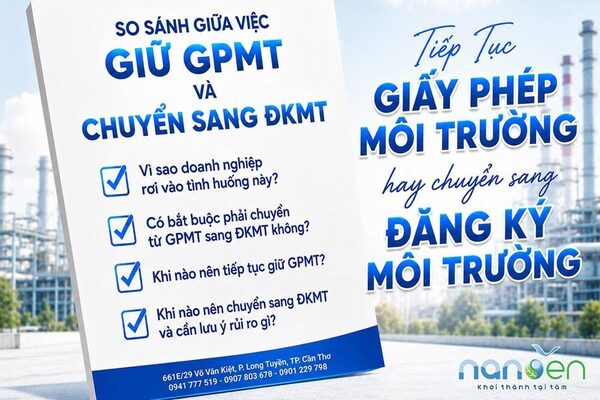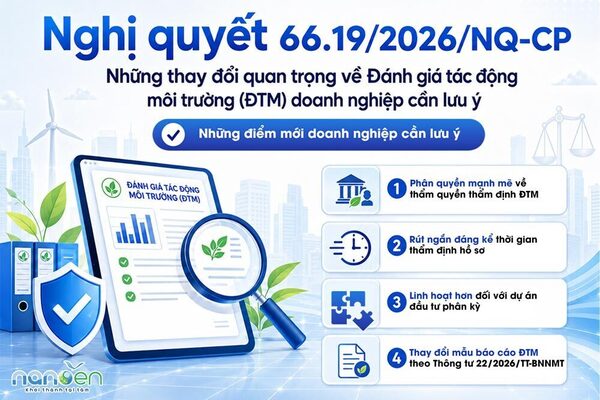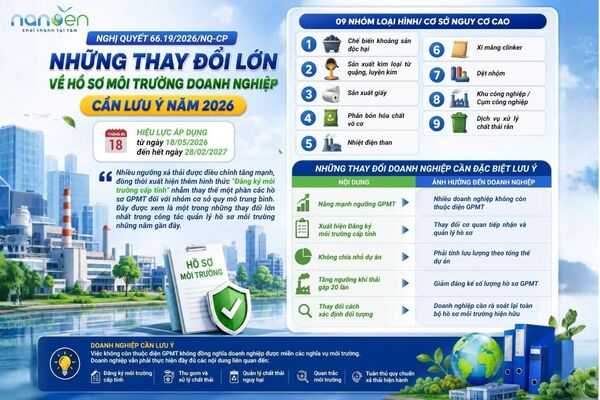


Resolution No. 66.19/2026/NQ-CP has adjusted the thresholds for determining entities subject to an Environmental Permit, thereby expanding the group of investment projects and operating facilities eligible to carry out environmental registration instead of undergoing the permitting procedure.
This is a positive change for the business community. It shortens the time required for dossier preparation, simplifies administrative procedures, and significantly reduces the burden of ex-ante regulatory review.
However, this very simplification may lead to an incomplete understanding: that once a project or facility is no longer subject to an Environmental Permit, its legal responsibilities for environmental protection are also reduced.
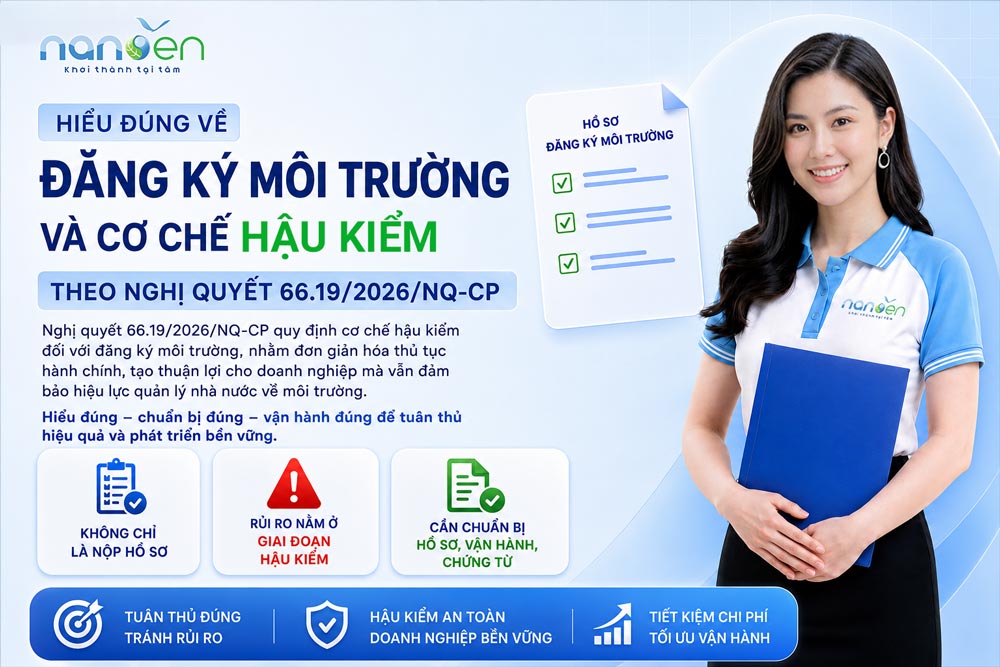
In practice, environmental registration does not eliminate the responsibilities of businesses. The new mechanism only changes the method of regulatory management: reducing ex-ante review, increasing ex-post inspection, and strengthening the responsibility of project owners and facility owners for the contents they have registered.
How Should Environmental Registration Be Understood?
Environmental registration is not an administrative licensing procedure. Therefore, it does not operate under the same appraisal and permitting mechanism as an Environmental Permit.
Unlike an Environmental Permit, environmental registration is not subject to appraisal, approval, or licensing. The competent state authority receives the registered information, while the project owner or facility owner is responsible for the completeness, accuracy, and truthfulness of the information submitted.
Accordingly, environmental registration should be understood as a mechanism under which a project owner or facility owner self-declares and submits information on production activities, waste generation sources, and environmental protection measures to the competent authority in accordance with applicable regulations.
Further reading: Major changes in environmental dossiers that businesses need to note
Pursuant to Resolution No. 66.19/2026/NQ-CP, an investment project that is not subject to environmental impact assessment and is not required to obtain an Environmental Permit must carry out environmental registration before commencing construction, except where environmental registration is not required under the applicable regulations.
The authority receiving environmental registration dossiers is divided into two levels: provincial level and commune level.
Provincial-Level Environmental Registration
Provincial-level environmental registration is a new regulatory mechanism established based on specific waste generation thresholds set out in Appendix IX of Resolution No. 66.19/2026/NQ-CP.
This dossier falls under the receiving authority of the provincial People’s Committee when an investment project or facility has one of the following characteristics:
-
It generates wastewater discharged into the environment that must be treated, with a total flow rate of 50 m³/day or more, and is not subject to an Environmental Permit;
-
It generates dust or exhaust emissions discharged into the environment that must be treated, with a total flow rate from 20,000 m³/hour to below 100,000 m³/hour.
Commune-Level Environmental Registration
Commune-level environmental registration applies to investment projects or facilities that are subject to environmental registration but have wastewater, dust, or exhaust emission generation levels below the thresholds for provincial-level environmental registration.
This dossier falls under the receiving authority of the commune-level People’s Committee, including wards and townships.
In general, the commune-level environmental registration group usually includes facilities with smaller-scale waste generation, specifically:
-
Facilities generating wastewater discharged into the environment that must be treated, but with a flow rate below 50 m³/day;
-
Facilities generating dust or exhaust emissions discharged into the environment that must be treated, but with a flow rate below 20,000 m³/hour;
-
Facilities not subject to an Environmental Permit;
-
Facilities not falling under cases exempted from environmental registration under the applicable regulations.
A Simpler Dossier Does Not Mean Lighter Responsibility
The key difference between an Environmental Permit and environmental registration lies in the control mechanism.
For an Environmental Permit, the dossier is reviewed by the competent authority before the permit is issued. For environmental registration, the business proactively declares the required information and assumes responsibility for the registered contents.
This means that the project owner or facility owner must clearly understand its own operations and ensure that the information stated in the dossier accurately reflects actual conditions, particularly:
-
Production type and capacity;
-
Sources of wastewater, dust, and exhaust emissions;
-
Waste generation flow rates;
-
Waste collection and treatment works;
-
Waste management plans;
-
Environmental protection measures currently being implemented.
If the declaration is incomplete, waste sources are incorrectly identified, or outdated data that no longer reflects actual operating conditions is used, the business may face risks when the regulatory authority conducts inspection, examination, or ex-post compliance review.
Further reading: What should businesses prepare when receiving an environmental protection inspection delegation?
Therefore, the reduction of dossier-related procedures should be understood as a measure to facilitate production and business activities, not as a reduction of the business’s legal responsibility for environmental protection.
What Benefits Do Businesses Gain from the New Mechanism?
The transition of certain entities from the Environmental Permit mechanism to environmental registration provides several clear benefits:
-
Shorter time for dossier preparation and implementation;
-
Fewer appraisal and pre-implementation review steps;
-
Reduced administrative costs;
-
More favorable conditions for investment, production, and business activities.
However, these benefits are meaningful only when the business correctly determines the applicable dossier type and prepares the dossier properly from the outset.
If the business incorrectly identifies the dossier type, submits the dossier to the wrong receiving authority, or registers contents that do not reflect actual conditions, it may not only be required to repeat the procedure but may also face legal risks during its operation.
When Ex-Post Inspection Becomes the Focus
Reducing ex-ante review does not mean reducing environmental inspection and supervision.
The regulatory authority may still inspect compliance, collect waste samples, and compare the registered contents against the actual operating status of the project or facility.
During this process, the issues reviewed are not limited to whether wastewater or exhaust emissions meet applicable technical standards. They also include the consistency between the dossier and actual operations, such as:
-
Whether the operating capacity is consistent with the registered contents;
-
Whether waste sources arise as declared;
-
Whether treatment works have been constructed and operated appropriately;
-
Whether wastes are managed in accordance with regulations;
-
Whether changes during operation have been reviewed and updated in a timely manner.
Accordingly, the responsibility of the business does not end at the time the environmental registration dossier is submitted. The registered contents must be maintained and demonstrably complied with throughout the entire operation period.
Environmental Registration Should Be Viewed as a Compliance Commitment
Environmental registration is not merely a procedure replacing an Environmental Permit.
It is a mechanism under which the business proactively discloses information relating to its environmental impacts and commits to implementing the registered contents properly.
Businesses need to understand three core points:
-
First, not every project that is not subject to an Environmental Permit is automatically required to carry out provincial-level environmental registration.
-
Second, flow rate thresholds are only one component in determining legal obligations.
-
Third, the project owner or facility owner is responsible for the accuracy of the dossier and the consistency between the registered contents and actual operations.
Properly understanding these points will help businesses take advantage of the benefits of administrative simplification while minimizing risks during inspection and operation.
Nanoen Accompanies Businesses in Preparing Environmental Dossiers in Compliance with Regulations
Determining whether a project or facility is subject to an Environmental Permit, provincial-level environmental registration, commune-level environmental registration, or exemption from environmental registration must be assessed based on the dossier and the actual conditions of each business.
Nano Environmental Technology - Construction Limited Liability Company (Nanoen) supports businesses in reviewing applicable subjects, determining the correct type of environmental dossier, preparing environmental registration dossiers, and checking the consistency between legal dossiers and actual operating conditions.
Doing it correctly from the outset not only helps businesses save time and costs but also establishes a stable compliance foundation throughout the entire course of operation.
We provide services including environmental documentation consulting, design – construction – operation of treatment systems, as well as training and operational optimization tailored to each business’s actual conditions.
With a long-term partnership approach, Nanoen focuses on delivering suitable solutions that ensure regulatory compliance while optimizing implementation costs.
Contact Nanoen today via HOTLINE 0941 777 519 - 0907 803 678 - 0901 229 798 for consultation and environmental documentation review tailored to your specific case
Nanoen
NANO ENVIRONMENT TECHNOLOGY - CONSTRUCTION LIMITED LIABILITY COMPANY
Address: 661E/29 Vo Van Kiet, Long Tuyen Ward, Can Tho City
Hotline: 0941.777.519 - 0907.803.678 - 0901.229.798
Email: nanoentech@gmail.com
Facebook: www.facebook.com/nanoentech