


During the process of reviewing environmental compliance dossiers under new regulations, many businesses are facing a practical situation: their facilities have already been granted an Environmental Permit (GPMT), and the permit remains valid; however, when reassessed against Resolution No. 66.19/2026/NQ-CP, the facilities may no longer fall under the category requiring an Environmental Permit and may instead be eligible to carry out Environmental Registration (ĐKMT).
The key question is: are businesses required to prepare and submit a new Environmental Registration dossier? If not mandatory, should they proactively switch to Environmental Registration to reduce operating compliance costs, or should they continue using the existing Environmental Permit to maintain legal certainty?
This is not merely a procedural issue. It is a compliance decision that requires businesses to balance costs, post-compliance inspection risks, and their long-term environmental compliance strategy.
Why Do Businesses Fall into This Situation?
This situation usually arises from two main causes.
Changes in Production Activities
First, the business may have changed its production activities, such as reducing production capacity, cutting down production lines, changing technologies, suspending certain waste-generating processes, or upgrading environmental treatment systems in a way that reduces environmental impacts.
Changes in Legal Classification Thresholds
Second, legal regulations may have changed the thresholds used to determine whether a facility is required to obtain an Environmental Permit. When these classification thresholds are adjusted, some facilities that were previously subject to Environmental Permit requirements may no longer fall into this category and may instead be classified as facilities subject to Environmental Registration, either at the provincial or commune level, depending on the scale of waste generation.
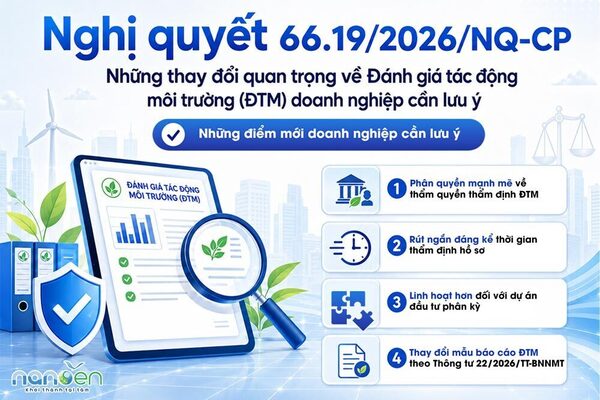
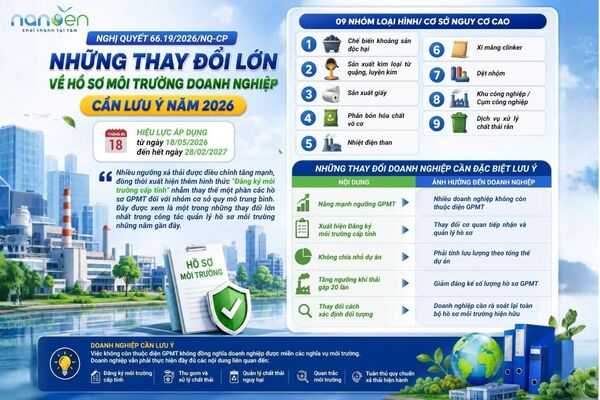
Further reading: Resolution No. 66.19/2026/NQ-CP: Major Changes in Environmental Compliance Dossiers That Businesses Should Take Note of in 2026
In essence, this regulatory change may benefit businesses by simplifying compliance dossiers and reducing the burden of pre-approval review. However, businesses must understand the change correctly to avoid switching dossiers mechanically without proper assessment.
Explanation of Pre-Approval Review and Post-Compliance Inspection
Pre-approval review means that the competent state authority examines and assesses the dossier before the business is granted approval, licensing, or permission to proceed.
Post-compliance inspection means that the business first makes declarations and takes responsibility for the accuracy of such declarations, while the competent authority inspects and verifies compliance later during the business’s operation.
Is It Mandatory to Switch from an Environmental Permit to Environmental Registration?
According to the transitional provisions under Clause 2, Article 4 of Decree No. 05/2025/ND-CP and Clause 2, Article 38 of Decree No. 48/2026/ND-CP:
Facilities and projects that were granted an Environmental Permit before the effective date of the new regulations, but are no longer subject to Environmental Permit requirements, may choose to continue using the issued Environmental Permit until its expiry date.
An issued Environmental Permit will cease to be valid if the project owner or facility carries out the Environmental Registration procedure.
Businesses Are Not Required to Switch Immediately
Therefore, the answer is: businesses are not required to immediately switch from an Environmental Permit to Environmental Registration if the current permit remains valid and the actual operation of the facility is still consistent with the licensed contents.
However, if a business chooses to carry out Environmental Registration to better reflect its current operating scale, it must conduct a careful review before making that decision. Once the business switches to Environmental Registration in accordance with regulations, its environmental obligations will be managed based on the registered contents, rather than the previously issued Environmental Permit.
Accordingly, the key question is not simply “whether the business is required to redo the dossier”, but rather: “Which option is more suitable for the business — continuing to use the issued Environmental Permit or switching to Environmental Registration?”
Comparison Between Keeping the Environmental Permit and Switching to Environmental Registration
| Criteria | Continuing with the Environmental Permit | Switching to Environmental Registration |
|---|---|---|
| Dossier status | The issued Environmental Permit continues to be used until its expiry date. | Environmental Registration is carried out, and the issued Environmental Permit will cease to be valid. |
| Management mechanism | The dossier has been reviewed and licensed by the competent authority. The business must comply with the contents specified in the issued permit. | The competent authority receives the registration contents. The business self-declares and takes responsibility for the accuracy of the information provided. |
| Level of legal certainty | Higher, provided that the facility operates in accordance with the Environmental Permit. | Depends on whether the business correctly identifies its applicable category and accurately declares its current operating status. |
| Periodic environmental monitoring | May be required in accordance with the Environmental Permit. | Not all facilities are required to conduct periodic monitoring; this depends on the applicable thresholds and types of waste generated. |
| Environmental protection fee for air emissions under Decree No. 153/2024/ND-CP | May be payable if the facility is subject to an Environmental Permit and the permit includes licensed air emission contents. | Usually not incurred if the facility is only subject to Environmental Registration and is no longer required to obtain an Environmental Permit. |
| Environmental protection fee for wastewater under Decree No. 346/2025/ND-CP | Still implemented in accordance with regulations on wastewater environmental protection fees, unless the facility qualifies for exemption. | Still implemented in accordance with regulations on wastewater environmental protection fees, unless the facility qualifies for exemption. |
| Risk of violation | Lower, provided that the dossier and actual operation remain consistent. | Higher if the business incorrectly identifies its regulatory category or inaccurately declares its actual operating conditions. |
| Suitable for | Businesses prioritizing legal stability and where ongoing compliance costs are not significant. | Businesses seeking to optimize compliance costs and having sufficient grounds to confirm that they are no longer subject to Environmental Permit requirements. |
Key Takeaways from the Comparison
It can be seen that an Environmental Permit is more stringent but provides greater legal certainty from a dossier perspective because it has undergone review by the competent authority.
In contrast, Environmental Registration may help reduce maintenance costs, especially certain environmental monitoring obligations or air emission fees if the facility is no longer subject to the relevant requirements.
However, the risk of Environmental Registration lies in the fact that the business must correctly determine its regulatory category, accurately declare its current operating status, and take responsibility when the competent authority conducts post-compliance inspection.
When Should a Business Continue Using Its Environmental Permit?
A business may consider continuing to use its Environmental Permit if the permit still has a long remaining validity period, if monitoring or reporting costs are not significant, if production activities remain stable and consistent with the licensed contents, or if the business is not yet certain that the facility is no longer subject to Environmental Permit requirements.
Cases Where Maintaining the Environmental Permit May Be Safer
If the business is planning to expand production capacity, add new production lines, or change technology in the near future, keeping the Environmental Permit may be the safer option.
This is because the dossier has already been reviewed by the competent authority, and the contents relating to waste sources, environmental treatment works, and environmental obligations have already been clearly established in the permit.
When Should a Business Switch to Environmental Registration, and What Risks Should Be Considered?
A business may consider switching to Environmental Registration when its Environmental Permit is close to expiry, when periodic monitoring costs or air emission fees are high, when production scale has clearly decreased, or when the facility has discontinued processes that pose a high risk of generating significant waste.
Cases Where Environmental Registration May Be Suitable
This option is more suitable when the facility’s current operation has become stable, there is no short-term plan for expansion, and the business has sufficient grounds to determine that the facility is no longer subject to Environmental Permit requirements.
Key Risks When Switching to Environmental Registration
Environmental Registration should not be understood as a simple dossier that can be completed quickly just for formality. The competent authority mainly receives the registration contents and does not appraise or issue a permit in the same manner as an Environmental Permit. Therefore, the greatest risk lies in the business incorrectly identifying its regulatory category or inaccurately declaring its actual operating conditions.
If the Environmental Registration dossier inaccurately records production capacity, waste sources, discharge flow rates, environmental treatment works, or environmental protection measures currently applied at the facility, the business may face risks during post-compliance inspection by the competent authority.
In such cases, the authority will not only consider whether wastewater or air emissions meet applicable technical regulations, but also whether the dossier is consistent with the facility’s actual operation.
Further reading: Understanding Environmental Registration and the Post-Compliance Inspection Mechanism under Resolution No. 66.19/2026/NQ-CP
Conclusion
A business that has already been granted an Environmental Permit but is no longer subject to Environmental Permit requirements is not necessarily required to immediately switch to Environmental Registration. However, the business should proactively review its current dossier and operating conditions to determine the most suitable compliance option.
Keeping the Environmental Permit may provide greater legal certainty from a dossier perspective, but it may also result in higher periodic compliance costs. Switching to Environmental Registration may help optimize costs, but it requires the business to correctly determine its applicable regulatory category, accurately declare its current operating status, and effectively manage post-compliance inspection risks.
So, should a business keep its Environmental Permit or switch to Environmental Registration? The answer must be assessed on a case-by-case basis, taking into account the remaining validity period of the existing permit, the scale of waste generation, environmental monitoring obligations, compliance maintenance costs, and planned changes in operations in the near future.
Nano Environmental Technology - Construction Limited Liability Company (Nanoen) supports businesses in reviewing existing environmental compliance dossiers, assessing the conditions for switching from an Environmental Permit to Environmental Registration, and checking the consistency between legal dossiers and actual facility operations.
This enables businesses to choose a suitable option that helps optimize costs while still ensuring compliance with environmental laws and regulations.
With a long-term partnership approach, Nanoen focuses on delivering suitable solutions that ensure regulatory compliance while optimizing implementation costs.
Contact Nanoen today via HOTLINE 0941 777 519 - 0907 803 678 - 0901 229 798 for consultation and environmental documentation review tailored to your specific case
Nanoen
NANO ENVIRONMENT TECHNOLOGY - CONSTRUCTION LIMITED LIABILITY COMPANY
Address: 661E/29 Vo Van Kiet, Long Tuyen Ward, Can Tho City
Hotline: 0941.777.519 - 0907.803.678 - 0901.229.798
Email: nanoentech@gmail.com
Facebook: www.facebook.com/nanoentech