

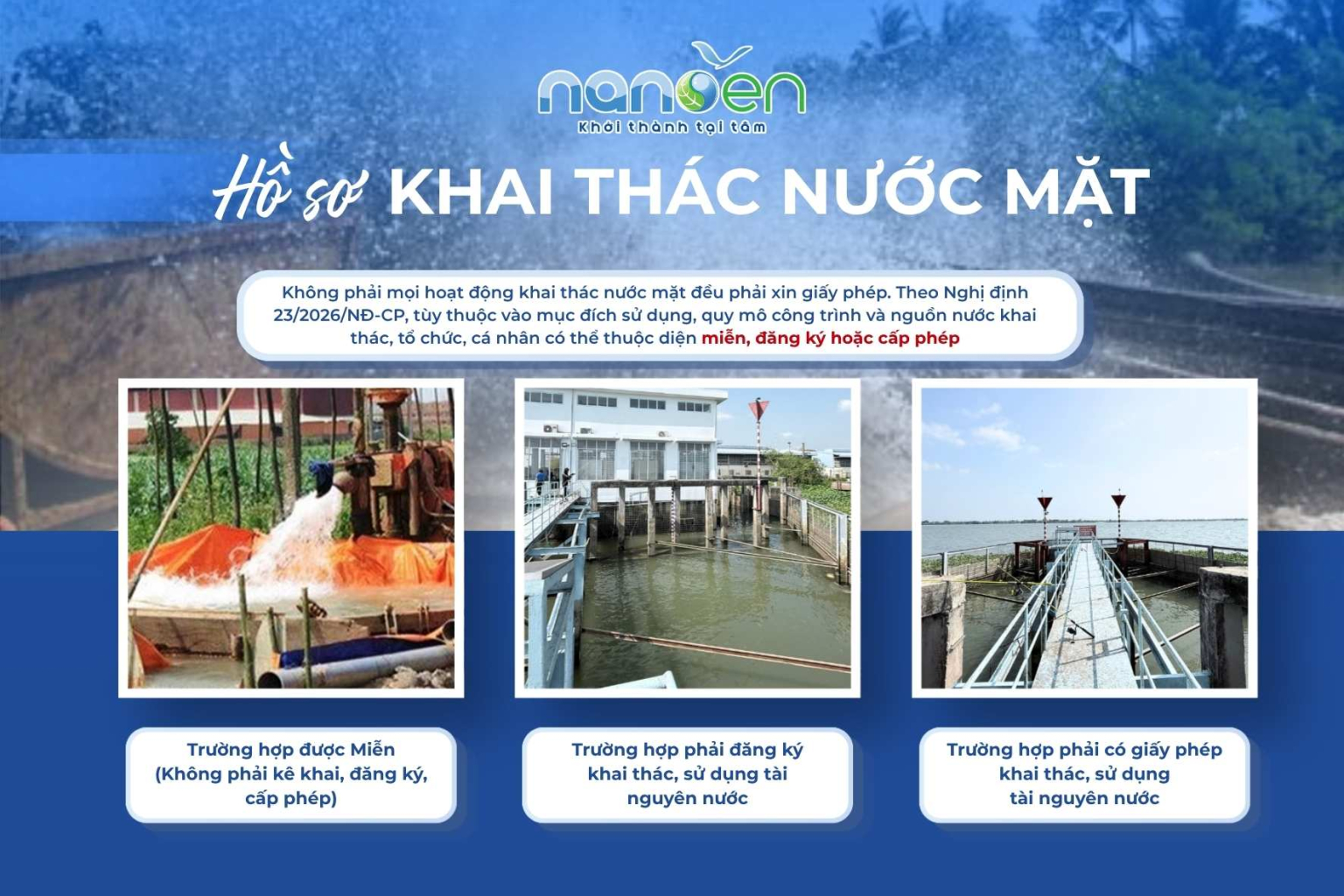
Do Businesses Always Need a Permit to Extract Surface Water?
This is one of the most common questions Nanoen receives.
Many businesses assume every surface water extraction requires a permit. Others believe small-scale operations require no paperwork at all.
In reality, not all extractions need a formal license. Under Decree 54/2024/ND-CP, as amended by Decree 23/2026/ND-CP, surface water usage is categorized into 3 compliance groups:
-
Exempt (No declaration, registration, or licensing required)
-
Registration required
-
Licensing required (Formal permit needed)
Determining your group depends on extraction purpose, facility scale, flow rate, and water source. Misclassifying your operation leads to incorrect dossiers, improper filings, and costly delays.
3 Regulatory Categories for Surface Water Extraction
1. Exempt Category (No Filings Required)
Under Decree 23/2026/ND-CP, small-scale or specific-purpose extractions are exempt from declaration, registration, and licensing:
-
Commercial, service, or non-agricultural production extraction under 100 m³/day.
-
Construction-related extraction for reservoirs, dams, or irrigation works under 100 m³/day.
-
Forestry and forestry-related service extractions.
-
Surface water usage for aquaculture or business with a surface area under 100 m².
Note: Being exempt from licensing does not mean bypassing general water resource management rules. Always verify your facility's operational parameters.
2. Registration Category
If your facility exceeds exemption limits but remains below licensing thresholds, you must register your extraction:
-
Irrigation reservoirs/dams with a capacity of 0.01 million to 0.5 million m³.
-
Agricultural or aquaculture extractions at 0.1 to 0.5 m³/second.
-
Surface water usage for aquaculture or commercial services over 100 m².
-
Surface water usage on reservoirs for solar power generation.
Registration is not a permit, but failing to register when required constitutes a regulatory violation.
3. Licensing Category (Formal Permit)
Businesses must apply for a formal Surface Water Extraction Permit when exceeding registration thresholds.
Additionally, Decree 23/2026/ND-CP mandates permits regardless of scale for direct extractions from:
-
Reservoirs and dams.
-
Irrigation canal networks and hydropower systems.
Key Updates in Decree 23/2026/ND-CP You Should Know
1. Adjusted Thresholds
Thresholds have been updated, shifting some facilities from licensing to registration or vice versa.
2. Fast-Tracked Processing Times
Administrative timelines have been significantly reduced:
-
New Permit Issuance: Reduced to 29 working days.
-
Permit Extension or Adjustment: Reduced to 23 working days.
-
Permit Re-issuance: Reduced to 10 working days.
3. Water Resource Rights Fee Regulations
New rules govern fee calculations and back-payments for facilities operating prior to full regulatory clearance.
What Does a Surface Water Extraction Dossier Include?
For facilities requiring a permit, the core dossier consists of:
-
Formal Application Form for Water Extraction Licensing.
-
Technical Scheme for Surface Water Extraction (tailored to facility type).
Action Plan for Businesses
Before submitting paperwork, follow these steps:
-
Audit Current Operations: Review extraction flow rate, water usage purpose, and current permit status.
-
Cross-Check Regulations: Verify status against Decree 23/2026/ND-CP.
-
Verify Financial Obligations: Check water rights fee requirements.
-
Prepare Accurate Dossiers: Ensure correct formatting and submission authority.
How Nanoen Supports Your Business
Determining your legal obligations is just step one. Nanoen provides end-to-end support:
-
On-site engineering survey of extraction facilities.
-
Classification assessment (Exempt, Registration, or License).
-
Complete dossier preparation complying with current standards.
-
Representation and liaison with state regulatory authorities.
-
Comprehensive environmental and water resource compliance consulting.
Nanoen
Frequently Asked Questions (FAQ)
Q1: Do small-scale surface water extractions require a permit?
Not always. Depending on scale, purpose, and facility type, small operations may be exempt or require registration instead.
Q2: Is registration the same as a license?
No. Registration is a simplified administrative procedure for smaller operations, whereas a license is a formal permit for larger or higher-impact extractions.
Q3: How long is a Surface Water Extraction Permit valid?
Permits are valid for 5 to 10 years and can be extended upon expiration.
NANO ENVIRONMENT TECHNOLOGY - CONSTRUCTION LIMITED LIABILITY COMPANY
Address: 661E/29 Vo Van Kiet, Long Tuyen Ward, Can Tho City
Hotline: 0941.777.519 - 0907.803.678 - 0901.229.798
Email: nanoentech@gmail.com
Facebook: www.facebook.com/nanoentech