

In recent years, the determination of entities subject to an Environmental Permit (EP) in Vietnam has mainly been based on project classification groups (Group I, II, III), combined with wastewater discharge volume and operational characteristics. However, with the issuance of Resolution No. 66.19/2026/NQ-CP, this regulatory approach has undergone significant changes.
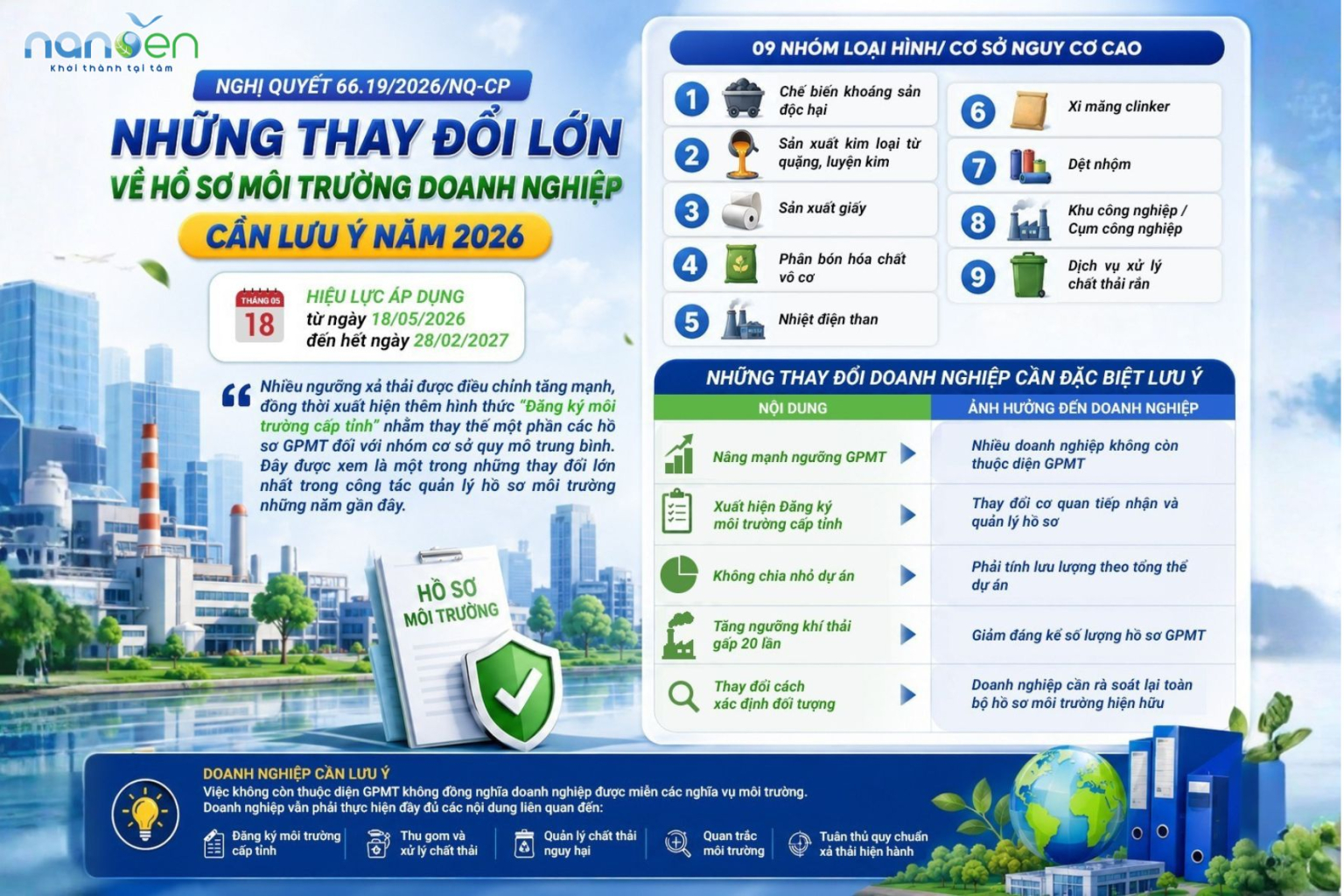
The Resolution is effective from May 18, 2026 to February 28, 2027. Accordingly, many discharge thresholds have been substantially increased, while a new mechanism called the Provincial Environmental Registration has been introduced to partially replace Environmental Permit requirements for medium-scale facilities. This is considered one of the most substantial changes in environmental documentation management in recent years.
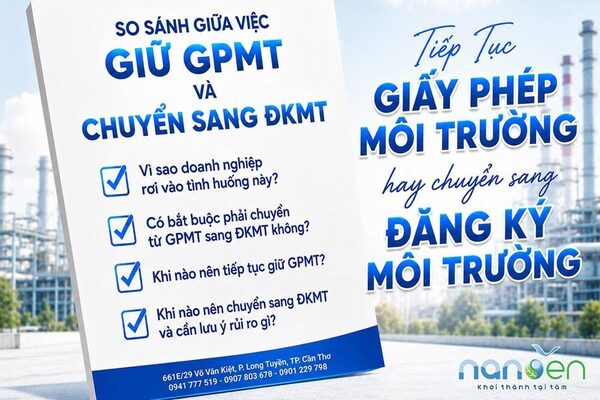
So, which businesses are still required to obtain an Environmental Permit? Which cases are now subject to Provincial Environmental Registration? And what are the key changes that enterprises should pay close attention to during investment, operation, or project expansion?
Let Nanoen walk you through the details below.
1. Comparison of ENVIRONMENTAL PERMIT (EP) Regulations
| Content | Previous Regulations | Under Resolution 66.19/2026/NQ-CP |
|---|---|---|
| Basis for determining EP applicability | Mainly based on project groups (Group I, II, III) combined with waste generation factors | Shifted to actual discharge volume and high-risk industry categories |
| High-risk industries (Appendix II) | Industrial wastewater or exhaust gas ≥ 5,000 m³/hour could trigger EP requirements | Only 09 high-risk industry/facility groups remain subject to EP and only when higher thresholds are met |
| Industrial wastewater threshold | EP required from 10 m³/day | Increased to 150 m³/day for standard projects |
| Domestic wastewater threshold | EP required from 50 m³/day | Shifted to Provincial Environmental Registration |
| Air emission threshold | From 5,000 m³/hour | Increased to 100,000 m³/hour |
| Hazardous waste & scrap import | Subject to EP | Mandatory EP requirement remains unchanged |
| Waste discharge calculation method | Could be considered by investment phases | Must be calculated based on the entire project scale |
| Management objective | Broad management through EPs | Focused management on facilities with large discharge volumes |
Important Note:
No longer being subject to an Environmental Permit does not mean that businesses are exempt from environmental obligations.
Enterprises must still comply with:
-
Provincial Environmental Registration
-
Waste collection and treatment
-
Hazardous waste management
-
Environmental monitoring
-
Compliance with applicable discharge standards
2. Comparison of ENVIRONMENTAL REGISTRATION Regulations
| Content | Previous Regulations | Under Resolution 66.19/2026/NQ-CP |
|---|---|---|
| Management authority | Mainly handled by Commune-level People’s Committees | Management divided between provincial and commune authorities |
| Provincial Environmental Registration | No separate mechanism | New Provincial Environmental Registration introduced |
| Applicable entities | No clear provisions | Applied to facilities with medium-scale discharge volumes |
| Wastewater threshold | Domestic wastewater ≥ 50 m³/day subject to EP | Total wastewater ≥ 50 m³/day shifted to Provincial Registration |
| Air emission threshold | ≥ 5,000 m³/hour subject to EP | From 20,000 to under 100,000 m³/hour shifted to Provincial Registration |
| Scale determination | Could be assessed by project phases | Determined based on the entire project |
| Management objective | Focused on EP management | Reduce EP applications while maintaining environmental supervision |
Important Note:
Provincial Environmental Registration is a new management mechanism for medium-scale facilities.
Businesses should review actual wastewater and exhaust gas volumes carefully to determine the correct regulatory authority and avoid filing incorrect procedures.
3. 09 HIGH-RISK INDUSTRY / FACILITY GROUPS
Under Resolution 66.19/2026/NQ-CP, the following 09 industry/facility groups continue to be subject to strict environmental management:
| No. | Industry / Facility Type |
|---|---|
| 1 | Toxic mineral processing |
| 2 | Metal production from ore and metallurgical processing |
| 3 | Paper manufacturing |
| 4 | Inorganic chemical fertilizer production |
| 5 | Coal-fired thermal power plants |
| 6 | Clinker cement production |
| 7 | Textile dyeing |
| 8 | Industrial parks / Industrial clusters |
| 9 | Solid waste treatment services |
Important Note:
Even for high-risk industries, an Environmental Permit is only required when:
-
Industrial wastewater ≥ 100 m³/day; or
-
Exhaust gas ≥ 100,000 m³/hour.
However, these industries remain under close environmental supervision during inspections, audits, and operational activities.
4. Cases Still Subject to Mandatory Environmental Permits
Although many discharge thresholds have been increased, the following cases are still required to obtain an Environmental Permit:
| Subject Group | Requirement |
|---|---|
| Hazardous waste treatment services | Mandatory EP |
| Scrap import for production materials | Mandatory EP |
| Specialized recycling and waste treatment activities | Mandatory EP |
| Facilities within the 09 high-risk groups exceeding discharge thresholds | Mandatory EP |
| Facilities outside the 09 high-risk groups exceeding discharge thresholds | Mandatory EP |
These entities continue to be strictly regulated due to their potential for significant environmental impacts.
Businesses should pay close attention to:
-
Legal environmental documentation
-
Trial operation procedures
-
Periodic environmental monitoring obligations
If a company plans to expand capacity, modify production technology, or upgrade treatment systems, environmental obligations should be reassessed under the new regulations to avoid compliance issues during investment and operation.
Businesses Should Proactively Review Environmental Documentation
The new changes regarding Environmental Permits and Environmental Registration may directly affect:
-
Existing environmental legal documents
-
Capacity expansion plans
-
New investment projects
-
Trial operation procedures
-
Environmental inspection and audit activities
Therefore, businesses should proactively review their current waste generation status and environmental documentation to minimize compliance risks during regulatory procedures.
In practice, determining whether a business falls under:
-
Environmental Permit requirements,
-
Provincial Environmental Registration, or
-
Other environmental obligations
requires evaluation based on multiple technical and legal factors, including:
-
Industry type
-
Waste discharge volume
-
Overall project scale
-
Environmental impact level
In cases where there are inconsistencies between previous Decrees and Resolution 66.19/2026/NQ-CP, the Resolution shall prevail.
For this reason, enterprises are encouraged to work with experienced environmental consulting firms to:
-
Properly assess regulatory applicability,
-
Identify potential legal risks, and
-
Develop appropriate environmental compliance roadmaps aligned with actual operational conditions.
Reputable Environmental Consulting Services in the Mekong Delta
Nanoen is an environmental consulting company with practical experience in implementing numerous projects and supporting businesses in handling environmental legal procedures.
We provide services including environmental documentation consulting, design – construction – operation of treatment systems, as well as training and operational optimization tailored to each business’s actual conditions.
With a long-term partnership approach, Nanoen focuses on delivering suitable solutions that ensure regulatory compliance while optimizing implementation costs.
Contact Nanoen today via HOTLINE 0941 777 519 - 0907 803 678 - 0901 229 798 for consultation and environmental documentation review tailored to your specific case
Nanoen
NANO ENVIRONMENT TECHNOLOGY - CONSTRUCTION LIMITED LIABILITY COMPANY
Address: 661E/29 Vo Van Kiet, Long Tuyen Ward, Can Tho City
Hotline: 0941.777.519 - 0907.803.678 - 0901.229.798
Email: nanoentech@gmail.com
Facebook: www.facebook.com/nanoentech