

/tram-lap-gieng-khong-su-dung-qcvn-83-2024-btnmt-web-nanoentech.jpg)
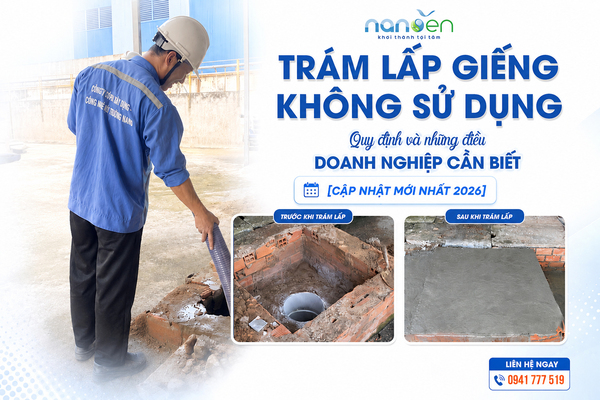
As of May 26, 2025, Circular No. 22/2024/TT-BTNMT issued by the Ministry of Natural Resources and Environment officially came into effect, promulgating QCVN 83:2024/BTNMT – National Technical Regulation on the Sealing and Abandonment of Unused Wells, replacing Circular No. 72/2017/TT-BTNMT.
Key updates introduced under Circular No. 22/2024/TT-BTNMT provide more detailed regulations on the well abandonment process, covering stages from inspection, cleaning, and material preparation to step-by-step implementation, with the aim of ensuring safety and preventing groundwater contamination.
In addition, the new Circular introduces clearer provisions on the handling of casing pipes and post-abandonment reporting obligations, thereby enhancing regulatory oversight and effective management.
Xem thêm: Hồ sơ phương án trám lấp giếng (Thông tư 72/2017/TT-BTNMT)
To help enterprises clearly understand the important changes in the well abandonment process, this article by Nanoen provides detailed guidance on standard-compliant well sealing procedures, while also clarifying the technical construction requirements for sealing unused wells in accordance with Circular No. 22/2024/TT-BTNMT.
Why Is Well Sealing and Abandonment Necessary?
The sealing and abandonment of unused wells is critically important to prevent groundwater contamination. This process must be carried out in a timely manner to block the intrusion of surface water and pollutants into aquifers, prevent hydraulic connectivity between different aquifer layers through the well, and ensure compliance with technical standards and regulations on safety, groundwater protection, and the prevention of groundwater degradation and depletion.
/hoan-thang-tram-lap-gieng-khong-su-dung.jpg)
Sealed and Abandoned Well
Procedure for Sealing and Abandonment of Unused Wells
Below is the procedure for sealing and abandoning unused wells in accordance with QCVN 83:2024/BTNMT:
/quy-trinh-tram-lap-gieng-QCVN-83-2024-cap-nhat.jpg)
Step-by-Step Procedure for Sealing and Abandonment of Unused Wells
Below is the standard procedure for sealing and abandoning unused wells in accordance with QCVN 83:2024/BTNMT:
Step 1: Notification of Well Sealing and Abandonment
-
Wells owned by organizations:
Prior to sealing drilled wells, dug wells, geological exploration wells, or mineral exploitation wells, the well owner must submit a notification and well sealing plan (using Appendix A template) to the Department of Natural Resources and Environment (now the Department of Agriculture and Environment) at least 10 days before construction begins. -
Wells owned by households or individuals:
Prior to sealing, the well owner must submit a notification using Appendix B template to the Commune-level People’s Committee at least 10 days before construction begins.
Step 2: Inspection and Assessment of Well Condition
-
Inspect and measure static water level (if applicable), well depth, and well diameter; assess the well’s openness and identify any obstructions inside the well.
-
Inspect and evaluate the feasibility of extracting casing pipes (for drilled wells with casing).
If casing removal is feasible, appropriate tools, machinery, and equipment must be prepared to ensure casing extraction is carried out simultaneously with the sealing process.
Step 3: Well Cleaning
-
Remove debris, waste, and any obstructions inside the well (if any) before commencing sealing operations.
Step 4: Preparation of Materials, Equipment, Machinery, and Workforce
Materials for sealing drilled wells
-
Organizational wells:
Use grout materials (cement, bentonite, natural clay) or granular materials (clay pellets, water-absorbent and swelling materials). -
Household/individual wells:
Select materials suitable to actual site conditions, ensuring prevention of polluted water intrusion and blocking hydraulic connectivity between aquifers.
Materials for sealing dug wells
-
Use soil, natural clay, or materials with waterproofing properties equivalent to surrounding geological layers.
Manpower, tools, and equipment
-
Prepare adequate machinery and tools suitable for each type of well.
-
If grout is used, grout injection pipes or pumping equipment must be available to ensure proper technical execution.
Step 5: Well Sealing and Abandonment Construction
Sealing of drilled wells
-
Equipment setup: Prepare appropriate tools and machinery.
-
Casing inspection:
If feasible, extract casing pipes in sections of no more than 10 meters each. -
Sealing with grout mixture:
Pour or pump grout in sections (≤10 meters) while gradually extracting the casing. -
If casing extraction is not feasible:
Near ground level (≥1 meter), cut off the casing and backfill the well using soil, gravel, or sand. -
Sealing with granular materials:
Slowly pour materials and continuously check to avoid blockages.
For dry wells, add water before sealing.
Apply similar procedures for wells with casing.
Sealing of dug wells
-
Use soil, natural clay, or equivalent materials.
-
Backfill in layers and compact thoroughly.
-
The top layer (≥1 meter) must be filled with natural soil or sand.
Site restoration
-
Remove construction equipment.
-
Clear excess materials and ensure environmental sanitation.
Step 6: Reporting of Well Sealing Results
-
Wells owned by organizations:
Within 10 days after completion, the well owner must submit a completion report using Appendix C or D templates to the Department of Natural Resources and Environment (now the Department of Agriculture and Environment). -
Wells owned by households or individuals:
Within 10 days after completion, the well owner must submit a report using Appendix Đ template to the Commune-level People’s Committee for data consolidation and updating of water resource exploitation records.
Improper well sealing: penalties and important notes
/xu-phat-tram-lap-gieng-khoan-vi-pham-ky-thuat.jpg)
According to Decree No. 16/2020/ND-CP on Administrative Sanctions in the Field of Water Resources and Minerals, failure to properly seal unused wells or failure to comply with technical sealing procedures may result in the following administrative penalties:
-
Failure to seal unused wells in cases where a groundwater exploration or extraction permit is required:
Administrative fines ranging from VND 20 million to VND 25 million. -
Failure to seal wells after completion of use or when wells are damaged (applied per well) in cases not subject to groundwater exploration, extraction, or use permits:
Administrative fines ranging from VND 100,000 to VND 500,000. -
Improper sealing of drilled wells in violation of prescribed technical standards:
Administrative fines ranging from VND 20 million to VND 30 million. -
Failure to notify or report the results of sealing unused wells to the competent state authority as required:
Administrative fines ranging from VND 500,000 to VND 1 million.
Note: The above penalty levels apply to individuals and household businesses. For organizations, the fines may be up to twice the amounts specified above.
Important Notes When Sealing Unused Wells
Sealing unused wells is not simply a matter of filling them with soil or dumping materials into abandoned wells. It is a mandatory technical process, with detailed technical guidance provided in QCVN 83:2024/BTNMT – Technical Regulation on Sealing Unused Wells, aimed at preventing groundwater contamination and ensuring environmental safety. Improper execution not only causes environmental harm but may also result in administrative penalties.
Therefore, individuals, households, and enterprises are strongly advised to engage professional service providers with adequate technical capacity and legal qualifications to carry out well sealing works, ensuring full compliance with current regulations and avoiding unnecessary legal risks.
Introduction to Nanoen’s Well Sealing Documentation and Implementation Services
At Nanoen, we fully understand the importance of well sealing and strict compliance with environmental regulations. Sealing unused wells is a critical measure to protect the environment and ensure community safety. Proper well sealing ensures effective isolation between aquifers, as well as separation of aquifers from surface contamination sources. Therefore, enterprises must clearly understand the technical requirements and construction procedures to ensure that well sealing activities are carried out correctly, lawfully, and effectively.
Contact Nanoen today to receive a FREE consultation and optimal solutions tailored to your well sealing needs. Nanoen is committed to delivering high-quality, safe, and efficient services for your enterprise.
Nanoen
NANO ENVIRONMENT TECHNOLOGY - CONSTRUCTION LIMITED LIABILITY COMPANY
Address: 661E/29 Vo Van Kiet, Long Tuyen Ward, Can Tho City, Can Tho
Hotline: 0941 777 519 - 0901 229 798 - 0907 686 717
Email: nanoentech@gmail.com
Facebook: www.facebook.com/