

Sludge generated from industrial wastewater treatment systems is a type of waste that requires strict management due to its potential content of pollutants and hazardous constituents. Under the Law on Environmental Protection 2020 and its guiding regulations (Circular No. 02/2022/TT-BTNMT and Decree No. 45/2022/NĐ-CP), sludge is not automatically classified as hazardous waste. Instead, it must undergo sludge identification based on hazardous thresholds specified in national technical regulations, which then serve as the legal basis for appropriate waste management.
Regulatory Background
In previous periods, sludge identification was commonly conducted in accordance with the following technical regulations:
-
QCVN 07:2009/BTNMT – National Technical Regulation on Hazardous Waste Thresholds;
-
QCVN 50:2013/BTNMT – National Technical Regulation on Hazardous Thresholds for Sludge from Water Treatment Processes.
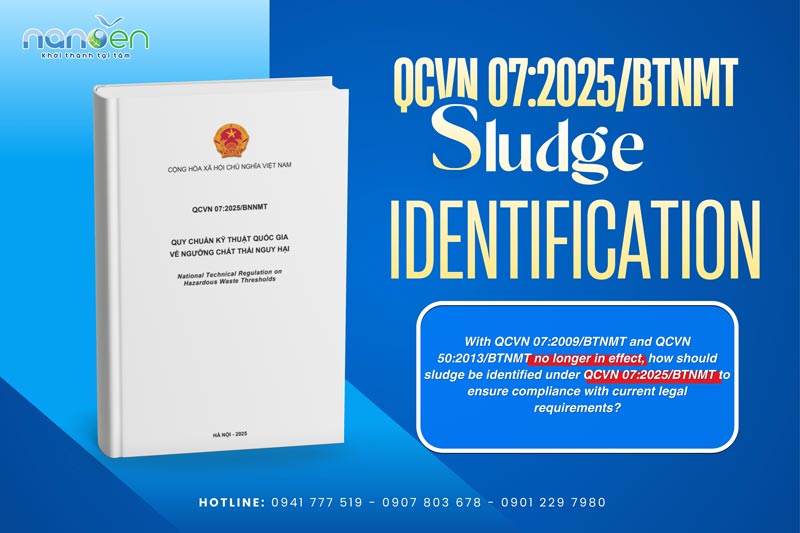
However, as of February 9, 2026, pursuant to Circular No. 44/2025/TT-BTNMT, QCVN 07:2025/BTNMT officially comes into force as the new national technical regulation on hazardous waste thresholds, fully replacing the above-mentioned regulations.
This regulatory transition raises a practical question for many enterprises:
When previous regulations cease to have effect, how should sludge identification be carried out to comply with QCVN 07:2025/BTNMT and ensure full compliance with current environmental laws?
The “Maximum Safety” Principle in Sludge Identification
The new regulation introduces more stringent criteria to minimize adverse environmental impacts:
-
Single-parameter exceedance: A waste is classified as hazardous waste (HW) if at least one hazardous characteristic or hazardous constituent exceeds the threshold specified in Table 1, Table 2, or Table 3 of QCVN 07:2025/BTNMT.
-
Unstable waste streams: If analytical results show that hazardous characteristics or constituents sometimes exceed and sometimes do not exceed regulatory thresholds, the entire waste stream must be identified as hazardous waste, unless identification is conducted separately for each individual batch.
Principles for Industrial Sludge Identification and Management under QCVN 07:2025/BTNMT
According to the Waste List promulgated together with Circular No. 02/2022/TT-BTNMT, industrial wastewater treatment sludge (waste code 12 06 05) is classified as “KS” – controlled industrial waste, and is not inherently hazardous waste (NH).
However, sludge bearing the “KS” code is only confirmed as non-hazardous when appropriate identification results are available.
Under QCVN 07:2025/BTNMT, sludge must be identified as hazardous waste if any single hazardous characteristic or hazardous constituent exceeds the thresholds set out in Tables 1, 2, or 3. This represents a significant change compared to QCVN 50:2013/BTNMT, which previously required simultaneous exceedance of two thresholds.
Notably, the regulation also establishes a clear management principle:
All waste classified under the “KS” category must be managed as hazardous waste until proven otherwise. This means that, in the absence of valid identification results, enterprises are legally justified—and required—to apply strict hazardous waste management measures from the outset.
In such cases, the waste generator is responsible for conducting at least one round of monitoring and analysis during operation to properly identify the waste.
Sampling Procedures for Regularly Generated Waste Streams
To determine whether sludge is hazardous, enterprises must compare analytical results against the quantitative thresholds for hazardous characteristics and constituents.
Because sludge from wastewater treatment systems is generated continuously and exhibits repetitive characteristics, sampling procedures must ensure high representativeness:
-
Sampling period: Samples must be collected on at least three different days.
-
Sampling time: On each day, samples must be taken at different time points (beginning, middle, and end of a production shift or batch).
-
Sampling method: At each time point, at least three random samples must be collected from different locations, then homogenized into one composite sample per day for analysis.
-
Comparison value: The average analytical result of the three days is used for comparison against hazardous waste thresholds.
Post-Identification Responsibilities and Record Retention
-
Qualified entities: Sampling and analysis must be conducted by organizations holding a valid Certificate of Eligibility for Environmental Monitoring Services.
-
Record retention: Enterprises are required to retain sludge identification and analytical records for a minimum of five (05) years for inspection purposes.
-
Re-identification: Sludge identification must be repeated whenever there are changes in production technology, raw materials, fuels, or chemicals that may alter sludge characteristics.
Why Is Sludge Analysis and Identification Necessary?
Wastewater treatment sludge must be specifically analyzed to determine whether it contains hazardous constituents such as heavy metals, oils and greases, solvents, or other substances with potential environmental impacts. Based on identification results, appropriate collection, storage, and treatment measures can be applied—either as hazardous waste or ordinary solid waste.
Under Article 29 of Decree No. 45/2022/NĐ-CP, violations related to hazardous waste management are subject to various administrative penalties, including:
-
Fines ranging from VND 10–20 million for improper collection or storage of hazardous waste; failure to maintain hazardous waste records; or failure to provide complete documentation for inspections.
-
Fines ranging from VND 40–50 million for failure to identify and classify hazardous waste according to prescribed codes, lists, and thresholds; incorrect declaration of hazardous waste quantity or type; or inaccurate or incomplete hazardous waste reporting.
Note: The above fines apply to individuals. Penalties imposed on organizations are doubled.
Ensuring Compliance and Minimizing Legal Risks
Conducting sludge analysis and preparing formal sludge identification reports not only fulfills compliance requirements under the new regulation, but also enables enterprises to better control operational processes, proactively develop suitable waste management plans, and minimize environmental and legal risks.
However, waste identification and classification go beyond laboratory analysis alone. They require a thorough understanding of regulatory requirements, waste generation characteristics, and accurate evaluation against current hazardous thresholds.
As QCVN 07:2025/BTNMT introduces stricter identification principles, enterprises should comprehensively review existing documentation, analytical results, and operational conditions to determine whether re-identification is required and to select appropriate sludge management solutions.
Nanoen – Your Partner in Sludge Identification and Environmental Compliance
Nanoen is ready to support enterprises in sludge identification consulting, reassessment under QCVN 07:2025/BTNMT, and the development of compliant and practical waste management solutions tailored to each facility’s operational conditions.
Hotline: 0941 777 519 | 0907 803 678 | 0901 229 798
Free initial consultation
Trusted and Fast Environmental Documentation Consulting in the Mekong Delta
Nanoen as a company operating in the environmental sector, Nanoen has earned the trust of its customers throughout its operation due to its honesty, dedication, and responsibility towards customers and the company's products.
In addition to providing comprehensive environmental consulting services, Nanoen also specializes in design and construction, operation of environmental treatment systems, supply of microbial products, and customized training for wastewater treatment system operation, tailored to the specific needs of each enterprise.
We are committed to delivering optimal products and services, fully addressing the diverse operational, technical, and regulatory requirements of our clients.
Nanoen
NANO ENVIRONMENT TECHNOLOGY - CONSTRUCTION LIMITED LIABILITY COMPANY
Address: 661E/29 Vo Van Kiet, Long Tuyen Ward, Can Tho City
Hotline: 0941.777.519 - 0907.803.678 - 0901.229.798
Email: nanoentech@gmail.com
Facebook: www.facebook.com/nanoentech