

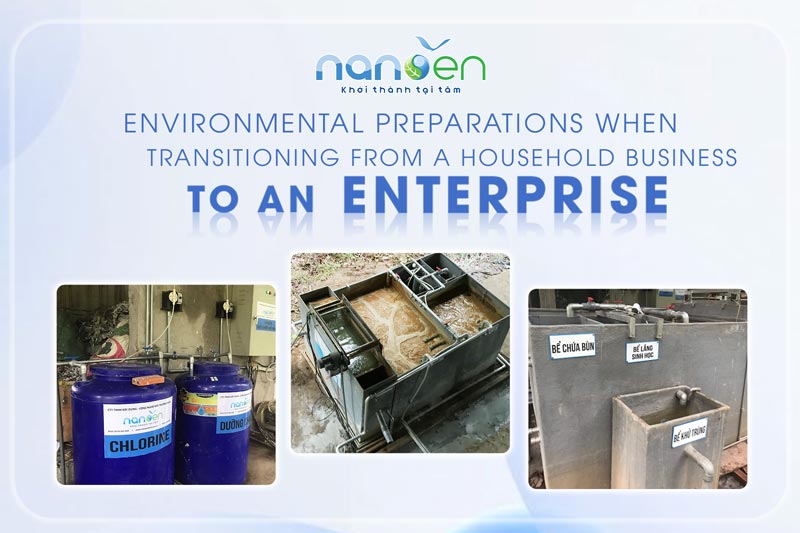
To transition from a household business to a small or medium-sized enterprise, business owners are required to complete the enterprise registration procedures in accordance with applicable laws. This transition presents opportunities to expand production scale, access larger sources of capital and partners, and enhance brand credibility in the market.
Along with expansion, enterprises must also prepare and fulfill all relevant legal obligations, ranging from business registration and taxation to environmental documentation and compliance with discharge standards, in order to ensure lawful and sustainable operations.
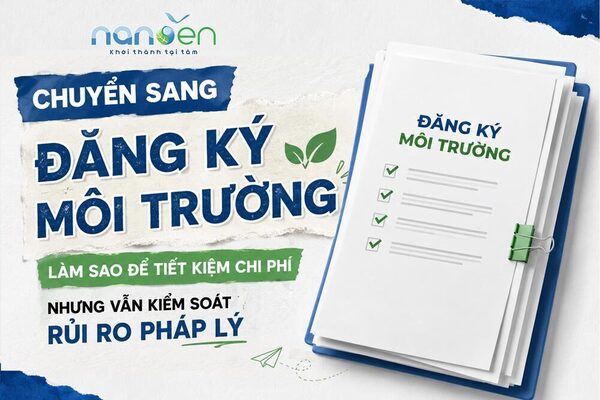
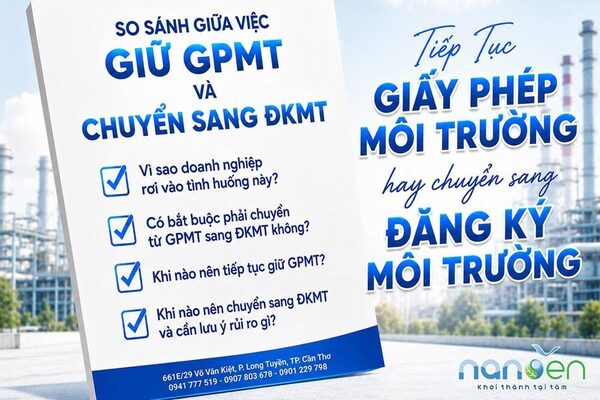
Mandatory Environmental Dossiers When Household Businesses Are Converted into Enterprises
Previously, for manufacturing household businesses, environmental documentation requirements were generally limited to an Environmental Protection Plan, Environmental Protection Commitment, or Environmental Protection Scheme. However, under the Law on Environmental Protection 2020, not only operating household businesses but also households planning to convert into small and medium-sized enterprises (SMEs) are required to review and reapply for appropriate environmental dossiers.
The required documentation may include Environmental Registration, Environmental License (EL), Periodic Environmental Protection Monitoring and Reporting, along with supporting documents related to solid waste management, air emissions, and wastewater discharge.
Properly completing these environmental procedures at the preparation stage helps business entities mitigate legal risks, ensure regulatory compliance, and establish a sustainable and lawful production operation after the conversion process.
Environmental Registration
Environmental registration procedures are carried out in accordance with the Law on Environmental Protection 2020 and its guiding regulations. This is a mandatory obligation for investment project owners and manufacturing, business, and service facilities to fully declare information related to their waste discharge activities, while committing to the implementation of appropriate environmental protection measures.
According to the regulations, entities subject to environmental registration are specified in Clause 1, Article 49 of the Law on Environmental Protection, including investment projects and facilities listed under the categories prescribed by law. Environmental registration must be completed prior to official operation of the facility, before the competent authority issues a construction permit, or before the commencement of waste discharge in cases where a construction permit is not required.
Environmental License
When a household business is converted into a small or medium-sized enterprise (SME) and expands its production scale, many cases are required to apply for an Environmental License (EL) in accordance with the updated regulations. This is a consolidated permit, replacing several previously separate environmental permits, and applies to facilities that generate air emissions, wastewater, or hazardous waste.
Under the Law on Environmental Protection 2020, not only large enterprises but also many small and medium-sized manufacturing facilities are subject to this mandatory procedure. In particular, since 2024, the competence for issuing Environmental Licenses has been revised, requiring enterprises to clearly understand the applicable authority in order to avoid submitting applications to the wrong agency or experiencing delays in dossier processing.
Obtaining and maintaining the validity of an Environmental License is not only a legal obligation, but also a critical basis for enterprises to demonstrate compliance with environmental regulations, build credibility with partners, and facilitate the expansion of production contracts.
See also: Which enterprises are required to obtain an Environmental License?
Failure to obtain or delays in implementing the Environmental License may expose enterprises not only to significant financial penalties, but also to more severe enforcement measures, such as mandatory suspension of operations, dismantling, or remediation of non-compliant facilities. These consequences can result in substantial economic losses and directly undermine an enterprise’s reputation as well as its ability to maintain contractual relationships with partners.
To mitigate these risks, enterprises should have a clear understanding of the applicable legal requirements and promptly update themselves on the latest regulatory changes.
See also: Key considerations for enterprises regarding Environmental Licenses
Periodic Environmental Protection Report
After an enterprise has obtained an Environmental License, a subsequent and essential requirement is the preparation and submission of the Periodic Environmental Protection Report (PEPR). This is a mandatory procedure applicable to manufacturing facilities that generate waste, serving to demonstrate that the enterprise is properly implementing the commitments stated in its approved environmental dossiers.
See also: What must enterprises do after obtaining an Environmental License?
Assessment and Upgrading of Wastewater Treatment Systems When Expanding Operational Scale
After an enterprise has completed its environmental dossiers and obtained approval from the competent authority, the approved documents will clearly specify the design capacity, discharge scale, and technical requirements for waste treatment. These approved contents serve as the mandatory legal basis for the enterprise to construct new or upgrade existing wastewater treatment systems.

Wastewater Treatment System of Van Bien Paper Factory with a Treatment Capacity of 5 m³/day·night
When increasing production capacity, enterprises must compare the projected pollution load specified in the approved environmental dossiers with the actual treatment capacity of the existing system. If the current treatment capacity is insufficient, system upgrading or retrofitting becomes mandatory to ensure compliance with applicable discharge standards.
See also: Upgrading and Retrofitting Wastewater Treatment Systems
Notably, the National Technical Regulation on Wastewater, issued by the Ministry of Agriculture and Environment, will officially take effect on September 1, 2025, introducing more stringent technical requirements. Even if the existing system is currently operating stably, enterprises are strongly advised to proactively assess their system’s ability to comply with the new standards in order to avoid regulatory and operational risks once the regulation is enforced.
See also: Updates on the National Technical Regulation on Wastewater 2025
Comprehensive Environmental Consulting Solutions for Enterprises Expanding Their Operations
Depending on the type of manufacturing or business activities and the operational scale, enterprises may be required to comply with additional specialized environmental documentation requirements or procedures related to hazardous waste management and other regulated waste streams.
To ensure the accuracy and completeness of environmental dossiers, enterprises are strongly advised to engage with a reputable environmental consulting firm. Environmental experts can assist in reviewing the latest legal regulations, identifying specific environmental obligations, and preparing dossiers in full compliance with applicable standards, thereby minimizing legal risks and optimizing implementation timelines.
Understanding the challenges and regulatory pressures enterprises face during operational expansion, Nanoen provides comprehensive environmental consulting services, covering the full scope from completion of environmental legal procedures to consulting on the upgrading and retrofitting of wastewater treatment systems in order to meet both current and forthcoming regulatory requirements. This integrated approach enables enterprises to confidently expand production while ensuring legal compliance and sustainable operation.
See also: Comprehensive Environmental Consulting Services
Contact us today to receive a free consultation and tailored solutions for your enterprise. We are committed to delivering high-quality, safe, and effective environmental services to support your long-term development.
Reputable and Professional Environmental Services in the Mekong Delta
Nano Environment Technology – Construction Limited Liability Company (Nanoen) is a trusted provider of professional environmental services in the Mekong Delta region. Throughout its operation, Nanoen has earned the confidence of clients through its integrity, dedication, and sense of responsibility toward customers as well as the quality of its products and services.
With a team of highly experienced professionals, we offer comprehensive environmental solutions, ranging from environmental dossier consulting to design and construction, operation of environmental treatment systems, wastewater treatment system operation training, and the supply of biological products and microorganisms, among others.
We are committed to delivering optimal products and services that fully meet the diverse needs of enterprises and support their compliance with environmental regulations.
Contact Nanoen today via our hotline 0941 777 519 – 0907 803 678 – 0901 229 798 to receive a FREE consultation.
Nanoen
NANO ENVIRONMENT TECHNOLOGY - CONSTRUCTION LIMITED LIABILITY COMPANY
Address: 661E/29 Vo Van Kiet, Long Tuyen Ward, Can Tho City, Can Tho
Hotline: 0941 777 519 - 0901 229 798 - 0907 686 717
Email: nanoentech@gmail.com
Facebook: www.facebook.com/nanoentech