

Why Is the Operation Phase a Legally Sensitive Period in Environmental Compliance?
Many enterprises assume that environmental legal procedures are completed once the Environmental Impact Assessment (EIA) is approved or an Environmental Permit (EP/GPMT) is obtained. However, under the Law on Environmental Protection 2020, the operation phase is in fact the stage where numerous critical legal obligations arise. It is also the period during which enterprises are more likely to be subject to inspections and sanctions if regulatory requirements are not fully complied with.
The operation phase not only requires strict compliance with permit conditions, but also involves periodic reporting, environmental monitoring, waste management, and payment of environmental protection fees. Any oversight may expose enterprises to legal, financial, and reputational risks.
Five Key Environmental Obligations During the Operation Phase
After being granted an Environmental Permit (EP/GPMT), enterprises are required to fulfill a series of legal obligations to ensure compliance with the Law on Environmental Protection 2020 and its guiding regulations. A clear understanding and proper implementation of these obligations are essential for effective risk management and sustainable development.
For a more in-depth and detailed overview of post–Environmental Permit obligations, enterprises may refer to the following article:
What should businesses do after obtaining an environmental permit?
Administrative Penalties for Violations in the Environmental Sector
Pursuant to Decree No. 45/2022/NĐ-CP on administrative penalties in the field of environmental protection, fines may range from several million to hundreds of millions of Vietnamese dong, depending on the nature and severity of the violation. Some typical cases include:
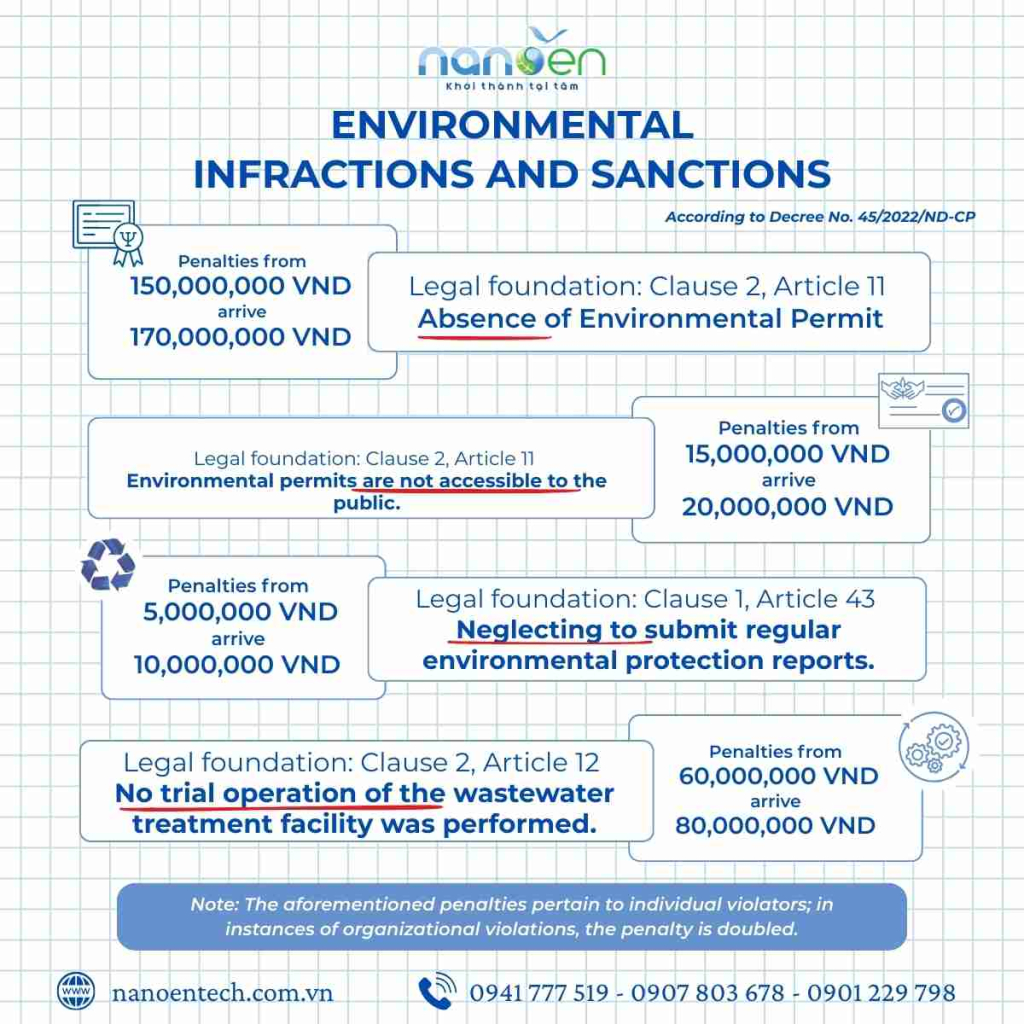
In addition to financial penalties, enterprises that violate environmental regulations may also suffer significant damage to their reputation and brand image. Currently, regulatory authorities often publicly disclose lists of non-compliant enterprises through official information channels, leading to a loss of trust among partners, customers, and the wider community.
These consequences are substantial, not only causing immediate impacts but also resulting in long-term effects on business cooperation, market development, and production expansion.
Review and Planning of Environmental Protection Activities for Enterprises
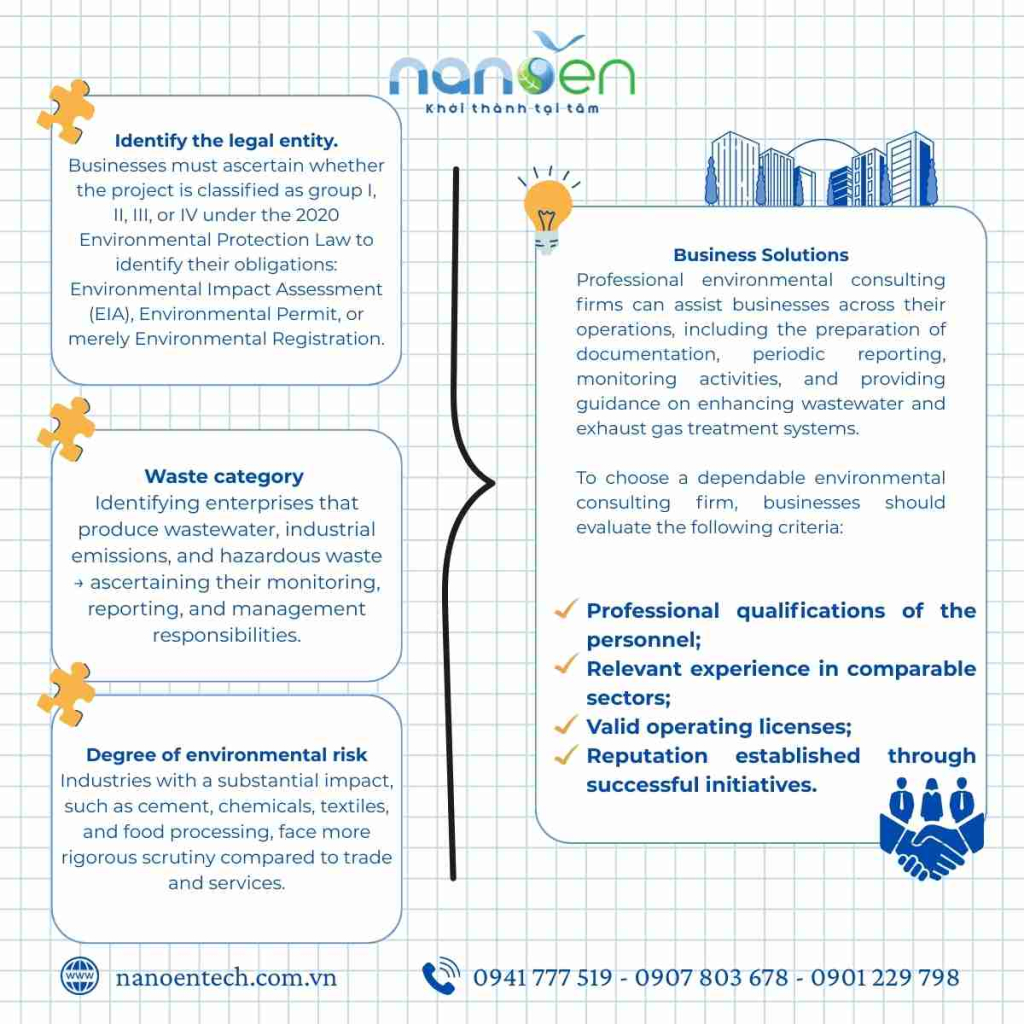
The first solution is for enterprises to proactively and periodically review all environmental legal obligations in a systematic manner. This review must be based on the enterprise’s business sector, operational scale, and production technology in order to accurately determine the applicable regulatory category. Proper and comprehensive compliance assessment enables early identification of gaps and helps enterprises avoid being unprepared during regulatory inspections.
Accordingly, enterprises should carry out an environmental legal compliance review, including the following key aspects:
-
Determination of legal classification:
Enterprises must accurately identify which of the four project groups (Groups I, II, III, or IV) their project falls under, as classified by the Law on Environmental Protection 2020. This classification forms the basis for determining whether the project is required to prepare an Environmental Impact Assessment (EIA), obtain an Environmental Permit (EP/GPMT), or only complete Environmental Registration. -
Types of waste generated:
Enterprises need to clearly identify the types of wastewater generated, and whether industrial air emissions or hazardous waste are produced. These factors are decisive in determining specific obligations such as periodic monitoring, reporting, and waste management requirements. -
Level of environmental risk:
Industries with higher potential environmental impacts (such as cement, chemical production, textile dyeing, and food processing) are subject to stricter regulatory oversight compared to commercial and service-oriented sectors.
Importantly, this review process should not be a one-time activity conducted only at the establishment stage, but must be continuously updated. As legal regulations and National Technical Regulations (QCVNs) are frequently amended or newly issued, enterprises’ environmental legal obligations also evolve accordingly
See also: Wastewater discharge standards for 2025
Optimizing Resources with Comprehensive Environmental Consulting Services
For many enterprises, especially small and medium-sized businesses, independently researching and complying with complex environmental regulations can result in significant time and resource inefficiencies. In such cases, partnering with a comprehensive environmental consulting service provider is an optimal solution.
Professional environmental consulting firms can support enterprises throughout their entire operational lifecycle, including preparing regulatory dossiers, periodic reporting, conducting environmental monitoring, and advising on upgrades to wastewater and air treatment systems.
See also: Comprehensive environmental solutions for small and medium-sized enterprises
To select a reliable environmental consulting firm, enterprises should consider the following criteria: the technical expertise of the consulting team, practical experience in similar industries, valid operating licenses, and a proven reputation built through successful projects. Choosing the right partner enables enterprises to transform regulatory compliance from a burden into a strategic competitive advantage.
For enterprises seeking comprehensive environmental solutions, Nano Environmental Construction – Technology Co., Ltd. (Nanoen) is a trusted partner. With a highly qualified team and extensive hands-on experience, Nanoen not only delivers high-quality, end-to-end environmental consulting services but also commits to long-term partnership, supporting enterprises in achieving sustainable legal compliance.
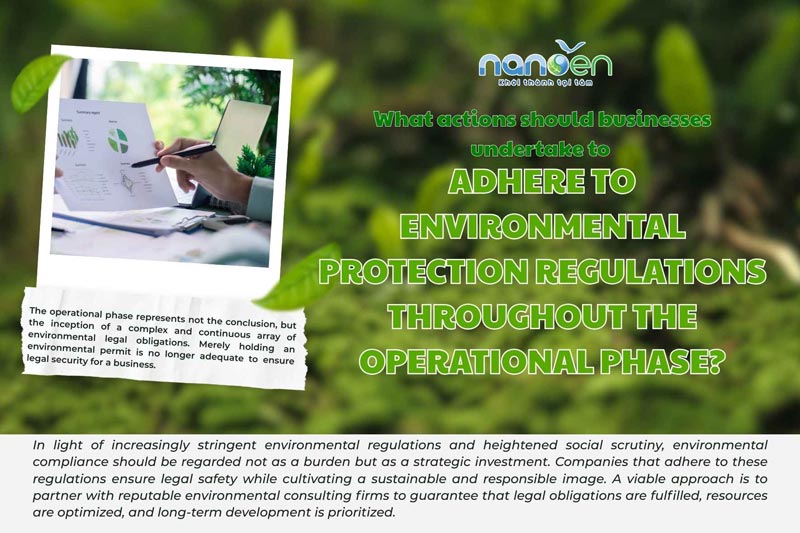
In a context where environmental regulations are becoming increasingly stringent and public oversight is intensifying, environmental compliance should not be viewed as a burden, but as a strategic investment. Compliant enterprises ensure legal security while building a sustainable and responsible corporate image. The most effective approach is to collaborate with a reputable environmental consulting firm to fulfill legal obligations, optimize resources, and pursue long-term, sustainable development.
A Provider of Comprehensive Environmental Solutions for Enterprises
To achieve these objectives, enterprises need to select a reputable and professional consulting firm capable of delivering comprehensive and effective environmental solutions.
Nano Environment Technology – Construction Limited Liability Company (Nanoen) is a trusted provider of professional environmental services in the Mekong Delta. With a team of experienced specialists and a deep understanding of both legal regulations and the practical needs of enterprises, we take pride in delivering end-to-end environmental consulting services with a high level of professionalism and effectiveness.
Throughout its years of operation, Nanoen has earned the trust of clients through integrity, dedication, and a strong sense of responsibility toward both customers and the quality of its products and services. We recognize that each enterprise has its own unique characteristics; therefore, Nanoen’s solutions are always custom-designed to suit specific industries and operational scales. From dossier preparation, report support, and assistance during regulatory inspections, to consulting on cost optimization and environmental management solutions, Nanoen is committed to partnering with enterprises, helping them not only fully comply with legal requirements but also enhance overall operational efficiency and business performance.
See also: The benefits of hiring a wastewater treatment system operator
Nanoen is committed to becoming a trusted partner for businesses, supporting them in overcoming environmental challenges and achieving sustainable development in the long term.
Through this article, Nanoen hopes to provide our valued clients with a clearer understanding of our comprehensive environmental consulting services, enabling informed decision-making based on practical needs and the advantages of partnering with us.
Contact us today for a free consultation and tailored solutions for your business. We are dedicated to delivering high-quality, safe, and effective services that support compliance, operational efficiency, and sustainable growth.
Nanoen
NANO ENVIRONMENT TECHNOLOGY - CONSTRUCTION LIMITED LIABILITY COMPANY
Address: 661E/29 Vo Van Kiet, Long Tuyen Ward, Can Tho City, Can Tho
Hotline: 0941 777 519 - 0901 229 798 - 0907 686 717
Email: nanoentech@gmail.com
Facebook: www.facebook.com/nanoentech