

In practice, many businesses still confuse the cases that require a new EIA, reissuance of an Environmental Permit, or simply an amendment to the existing permit. Misidentifying legal obligations may result in incorrect procedures, project delays, and operational risks.
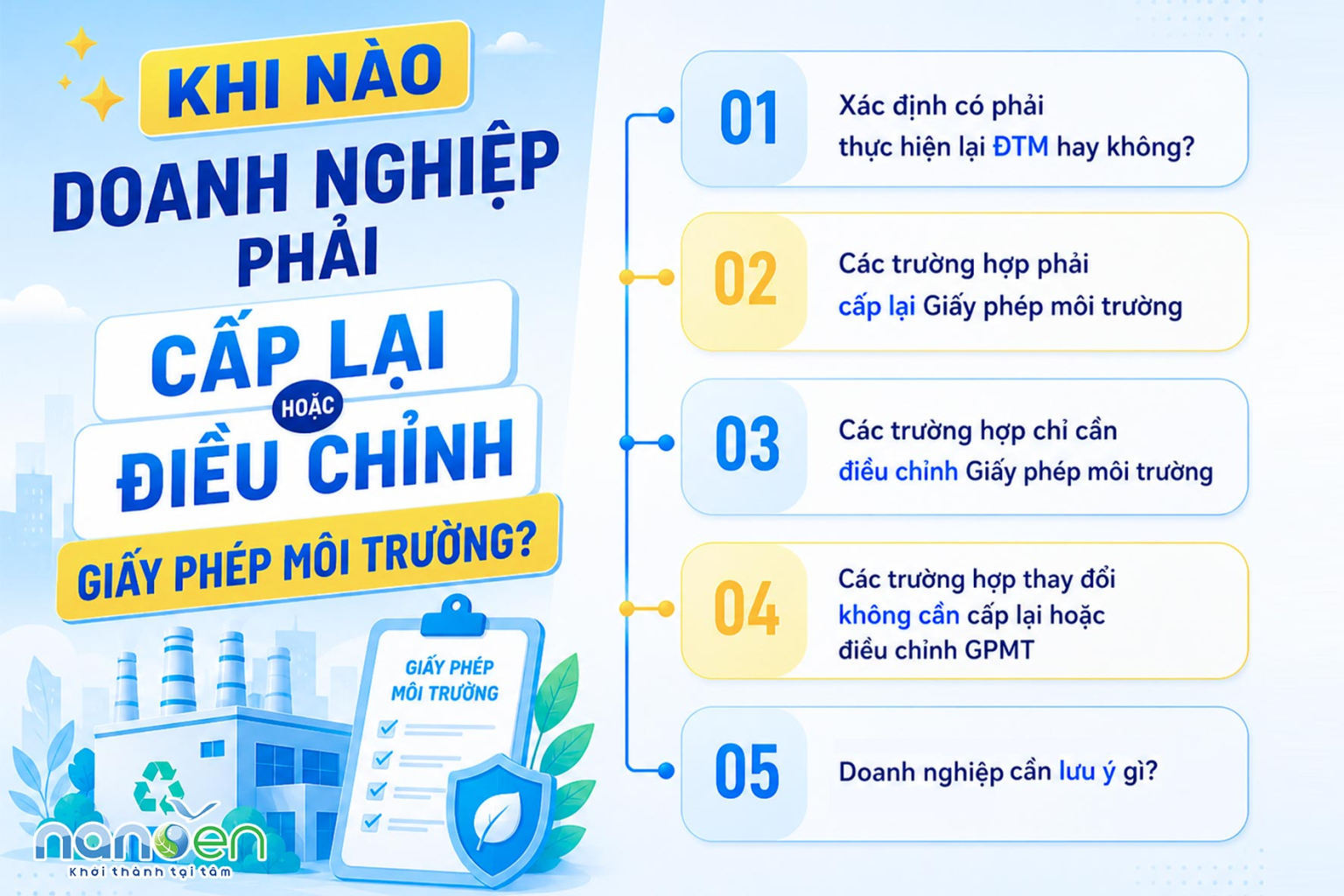
So, in which cases must a business reissue, amend, or reassess its environmental procedures? Businesses can consider the following sequence:
Determining Whether a New EIA Is Required
This is the first and most important step to consider when a business plans changes related to scale, capacity, or technology.
- Projects subject to EIA requirements under Point a, Clause 4, Article 37 of the Law on Environmental Protection.
- Changes in production scale or capacity by 30% or more that increase adverse environmental impacts (under Clause 9, Article 1 of Decree 05/2025/ND-CP amending Clause 2, Article 27 of Decree 08/2022/ND-CP).
- Other changes specified in Clause 6, Article 27 of Decree 08/2022/ND-CP, as amended and supplemented by Decree 05/2025/ND-CP and Decree 48/2026/ND-CP.
- In addition to capacity-related changes, modifications to production technology, input materials, or the generation of new waste sources may also trigger the requirement for a new EIA if they significantly increase environmental impacts.
Note: If a project falls under cases requiring a new EIA, the business cannot apply the standard Environmental Permit reissuance procedure for ordinary capacity changes.
After obtaining the Decision approving the EIA appraisal results, this approval will serve as the basis for competent authorities to consider issuing an Environmental Permit that matches the adjusted project conditions.
Cases Requiring Reissuance of an Environmental Permit
If the change does not reach the threshold requiring a new EIA but still increases adverse environmental impacts compared to the current permit, the business must apply for a reissued Environmental Permit.
Under the Law on Environmental Protection and related regulations, Environmental Permit reissuance is required in cases such as:
-
Expiration of the Environmental Permit.
-
An increase of 10% or more in wastewater, dust, or exhaust gas flow, resulting in higher pollutant loads.
-
Changes to wastewater discharge locations where the receiving source has stricter environmental protection requirements.
-
Changes to wastewater, exhaust gas, or waste treatment technologies.
-
Addition or modification of waste treatment activities.
-
Addition of hazardous waste categories (except where the newly added hazardous waste has characteristics similar to already permitted hazardous waste) for hazardous waste treatment service providers.
-
Addition of new imported scrap categories or increases in imported scrap volume.
-
Reduction in scale or failure to construct environmental incident prevention and response facilities.
-
Industrial parks or industrial clusters adding industries with a risk of environmental pollution under regulations.
Businesses must submit applications for Environmental Permit reissuance before implementing such changes and may only proceed after approval from competent authorities.
Note: For Environmental Permit reissuance cases involving technology changes, treatment facilities, or additional pollutant loads, businesses are required to conduct trial operation testing for the modified items.
Cases Requiring Only an Amendment to the Environmental Permit
Not all changes require Environmental Permit reissuance. In many cases, businesses only need to amend the Environmental Permit if the changes do not increase adverse environmental impacts beyond regulated thresholds.
Common cases include:
-
Changes to permitted contents at the request of the business, such as emission sources, discharge flow rates, or pollutant parameters.
-
Changes in scale, capacity, or technology that alter permit contents but do not yet require Environmental Permit reissuance.
-
Addition of plans for transferring or receiving wastewater for treatment.
-
Addition of wastewater reuse plans.
According to regulations, businesses must submit amendment applications before implementing the changes and may proceed only after receiving approval.
Cases That Do Not Require Reissuance or Amendment of the Environmental Permit
Under Law No. 146/2025/QH15, the “permit replacement” procedure for Environmental Permits has been abolished. Therefore, the following changes do not require reissuance or amendment procedures:
-
Changes to the project name or investor name.
-
Changes in ownership.
-
Changes unrelated to Environmental Permit contents.
Note: Businesses are not required to carry out Environmental Permit reissuance or amendment procedures in these cases. They only need to update the information in their periodic environmental protection reports.
What Should Businesses Pay Attention To?
In reality, determining the correct legal procedure depends not only on the scale of changes but also on:
-
The actual level of environmental impact.
-
Changes in production technology.
-
Waste treatment systems.
-
Pollutant loads generated after adjustments.
As a result, many businesses assume that only a permit amendment is needed, while in fact they may fall under cases requiring Environmental Permit reissuance or even a new EIA.
Incorrect assessments from the beginning may lead to:
-
Applying incorrect legal procedures.
-
Repeated adjustment costs.
-
Delays in project implementation.
-
Increased risks during environmental inspections and audits.
Therefore, businesses should proactively work with qualified environmental consultants to review current conditions, determine the correct procedures, and develop appropriate implementation plans from the outset to avoid unnecessary legal risks and costs.
Reputable Environmental Consulting Services in the Mekong Delta
Nanoen is an environmental consulting company with practical experience in implementing numerous projects and supporting businesses in handling environmental legal procedures.
We provide services including environmental documentation consulting, design – construction – operation of treatment systems, as well as training and operational optimization tailored to each business’s actual conditions.
With a long-term partnership approach, Nanoen focuses on delivering suitable solutions that ensure regulatory compliance while optimizing implementation costs.
Contact Nanoen today via HOTLINE 0941 777 519 - 0907 803 678 - 0901 229 798 for consultation and environmental documentation review tailored to your specific case
Nanoen
NANO ENVIRONMENT TECHNOLOGY - CONSTRUCTION LIMITED LIABILITY COMPANY
Address: 661E/29 Vo Van Kiet, Long Tuyen Ward, Can Tho City
Hotline: 0941.777.519 - 0907.803.678 - 0901.229.798
Email: nanoentech@gmail.com
Facebook: www.facebook.com/nanoentech