

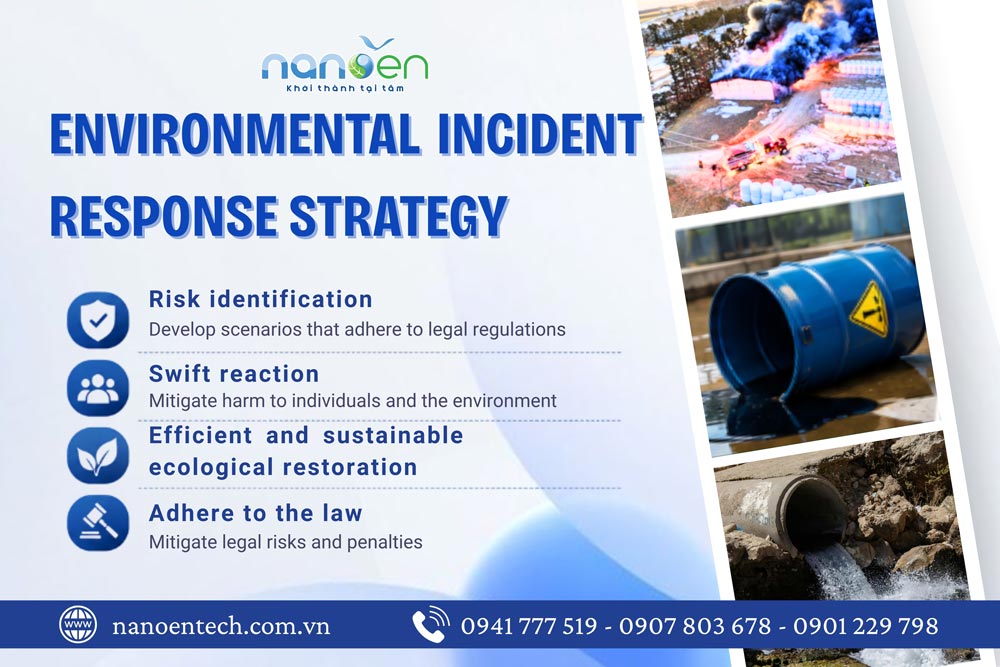
During operation, businesses are exposed to various environmental risks such as chemical leakage, wastewater treatment system failures, fire and explosion incidents, or uncontrolled waste discharge. Without a proper response plan, these incidents may not only interrupt business operations but also lead to legal liabilities and adverse impacts on the surrounding environment.
Therefore, businesses should proactively develop an Environmental Incident Response Plan to identify potential risks, prepare necessary resources, and ensure readiness when environmental incidents occur in practice.
So what should an environmental incident response plan include, and what should businesses pay attention to in order to comply with current regulations? Let Nanoen walk you through the key points in the article below.
Definition and Classification of Environmental Incidents
An Environmental Incident Response Plan is a document that identifies environmental risks, anticipates possible incident scenarios, and establishes corresponding response measures to ensure timely and effective handling when incidents occur in reality (According to Clause 1, Article 108 of Decree No. 08/2022/ND-CP).
Classification of Environmental Incidents
According to Article 123 of the Law on Environmental Protection 2020 and Clause 37, Article 1 of the Law amending and supplementing several provisions of 15 laws in the agriculture and environment sector, environmental incidents (including waste-related incidents) are classified into four levels to determine the competent response authority:
-
Facility level: Pollution remains within the premises of the facility or business.
-
Commune level: Pollution spreads beyond the facility but remains within one commune.
-
Provincial level: Pollution extends beyond a commune but remains within one province.
-
National level: Pollution affects two or more provinces or crosses national borders.
Main Contents of a Facility-Level Environmental Incident Response Plan
According to Clause 2, Article 108 of Decree No. 08/2022/ND-CP, businesses are responsible for issuing and implementing an incident response plan with at least the following contents:
Identification of Risks and Incident Scenarios
Businesses must identify potential sources of environmental incidents, such as chemical spills or failures in waste treatment systems, and develop corresponding response scenarios.
Prevention and Response Measures
The plan should specify emergency equipment, materials, backup facilities, and on-site response teams prepared for incident handling.
Training and Emergency Drills
Businesses are required to establish training programs and conduct periodic emergency response drills.
Notification and Communication System
The plan must define alarm methods, communication channels, and resource mobilization mechanisms during incidents.
Environmental Incident Response Measures
This includes measures to prevent pollutants from spreading into the surrounding environment, as well as remediation and environmental recovery measures required by environmental management authorities.
Issuance, Approval, and Integration of the Plan
Responsibility for Issuance
The facility owner is responsible for issuing the environmental incident response plan in accordance with the approved Environmental Impact Assessment (EIA) report or Environmental Permit.
Integration with Other Emergency Plans
The environmental incident response plan may be integrated into other emergency response plans. However, integrated plans must still contain all required contents specified in Clause 2, Article 108 of Decree No. 08/2022/ND-CP.
Public Disclosure and Emergency Drills
Public Disclosure
Businesses must publicly disclose the plan at the facility and submit it to the commune-level People’s Committee and the local civil defense authority. If the facility is located within an industrial park or export processing zone, the plan must also be submitted to the management board (According to Article 110 of Decree No. 08/2022/ND-CP).
Frequency of Emergency Drills
- General environmental incidents: Facility-level drills must be conducted at least once every two years (According to Clause 7, Article 124 of the Law on Environmental Protection 2020).
- Waste-related incidents: Under Decision No. 11/2025/QD-TTg, annual drills are required.
Participation Requirements
Relevant authorities and representatives of nearby communities potentially affected by the incident must participate in the drills.
Organization of Environmental Incident Response
Response Principles
Incident response must follow the “4 on-site principles”:
-
On-site command
-
On-site personnel
-
On-site equipment and materials
-
On-site logistics
Along with the “3 readiness principles”:
-
Proactive prevention
-
Timely response
-
Rapid remediation
Incident Reporting Procedure
When an incident occurs, the facility owner must immediately notify the commune-level civil defense authority and local government.
On-Site Command
The legal representative of the facility acts as the on-site commander. If the incident exceeds the facility’s response capacity, command must be transferred to the competent local authority.
Environmental Restoration After an Incident
The entity responsible for the incident must carry out environmental restoration within the affected area under the supervision of the commune-level authority.
The restoration plan should include:
- Environmental assessment
- Selection of technical remediation measures (physical, chemical, biological)
- Restoration work items
- Environmental monitoring program
Financial Responsibility and Compensation
Organizations or individuals causing environmental incidents are responsible for covering:
-
Incident response costs
-
Environmental restoration expenses
-
Compensation for affected parties
If the cause or responsible party cannot be identified, the State budget will bear the related expenses.
Important Notes During Environmental Inspections
Businesses are required to prepare:
-
The issued Environmental Incident Response Plan
-
Specific incident scenarios
-
Records and reports of periodic emergency drills
These documents serve as evidence of environmental compliance during inspections or audits.
Practical Considerations for Businesses
In practice, many businesses prepare environmental incident response plans merely for documentation purposes without fully reflecting actual operational conditions or potential risks at the facility. As a result, such plans may be ineffective during real incidents.
Therefore, businesses should carefully assess environmental risks, develop response scenarios suitable for their production activities, and ensure preparedness for practical emergency situations.
Nanoen – Environmental Consulting and Incident Response Support
Nanoen supports businesses in:
-
Developing environmental incident response plans
-
Reviewing environmental legal documentation
-
Consulting wastewater and waste treatment systems
-
Conducting emergency response training and drills
-
Supporting businesses during environmental inspections
Contact Nanoen for consultation tailored to your operational conditions and environmental management needs.
Nanoen
NANO ENVIRONMENT TECHNOLOGY - CONSTRUCTION LIMITED LIABILITY COMPANY
Address: 661E/29 Vo Van Kiet, Long Tuyen Ward, Can Tho City
Hotline: 0941.777.519 - 0907.803.678 - 0901.229.798
Email: nanoentech@gmail.com
Facebook: www.facebook.com/nanoentech